

How to Build a Trading Plan That Actually Works
Quick Answer
A trading plan is a written document that defines exactly how you trade, what pairs you watch, when you enter, how much you risk, and how you evaluate your performance.
Key Takeaways
- A trading plan is a written rulebook. If it’s not on paper, it doesn’t exist under pressure.
- The plan should cover 8 components: trading style, market selection, session times, entry rules, exit rules, risk parameters, journaling process, and review schedule.
- Your plan must match your actual lifestyle. A full-time worker cannot trade a scalping system that demands 6 hours of screen time.
- The best trading plans are simple enough to follow under pressure and specific enough to remove guesswork.
A lot of traders think having a trading strategy is the same as having a trading plan. Unfortunately, it’s not.
You can know your setup, understand market structure, and have a clear entry model but still struggle to stay consistent when you’re trading live. You keep trading even after you’ve already hit your daily limit. Sometimes, you simply don’t have a clear plan for what happens before, during, and after a trade. This points to the absence of a trading plan.
A good trading plan gives you those rules. It tells you how much to risk, what setups you will take, when you will stop for the day, and what you should do when a trade doesn’t go your way. And if you’re trading a prop firm challenge, these rules become even more important.
In this guide, we’ll walk through how to build a trading plan that is simple, realistic, and most importantly, something you can actually follow.
Trading presents us with a fundamental paradox: How do we remain disciplined, focused, and consistent in the face of constant uncertainty
What a trading plan actually is
A trading plan is a written document that answers one question: How do I trade?
It’s not “What do I think about the market?” or “What will EURUSD do this week?” Those are opinions. A trading plan articulates a clear and tangible trading process.
More specifically, a trading plan defines:
- What markets you trade and why
- Which sessions you’re active in
- What conditions need to be present before you enter
- How you size your position
- Where your stop loss goes
- Where your take profit goes
- How much you’re allowed to lose in a single day
- What you do after a losing streak
If any of those answers is “it depends” or “I decide in the moment,” that part of your plan is missing. This is where you exactly need a t rading plan.
What a trading plan is not
"Many times, when traders don't follow their trading plans, it's because those plans don't truly fit who they are."
A trading plan is not a list of indicators. “I use the 200 EMA and RSI” is a tool preference.
It’s not a vague intention. “Buy low, sell high” is a bumper sticker. It’s not a mental note. If it’s not written down, it will bend the moment your emotions spike after a losing trade.
A plan you copied from someone else’s YouTube channel is not your plan. It becomes yours only when every rule reflects how you actually trade, when you actually trade, and how much risk you can genuinely tolerate.
The 8 core components of a trading plan
Every functional trading plan answers 8 questions. Some traders build elaborate documents. Others use a one-page template. Length doesn’t matter. Completeness does.
1. Trading style
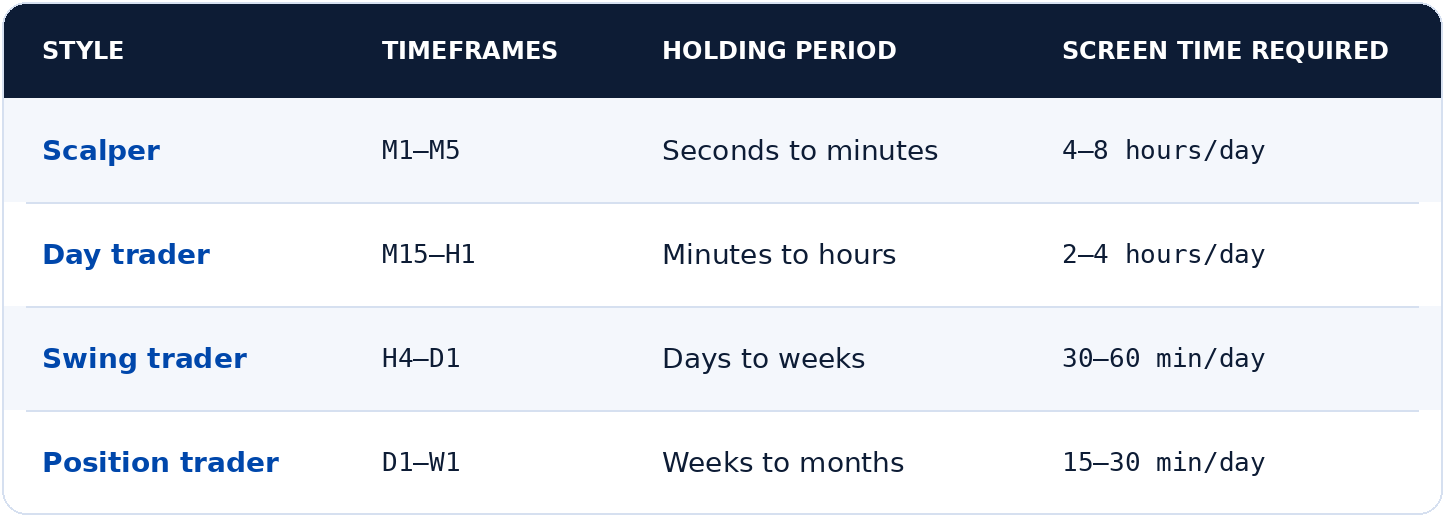
Are you a scalper, day trader, swing trader, or position trader? This decision shapes everything else like your timeframes, your screen time, your risk per trade, and which prop firm rules are realistic for you.
Be honest with yourself here. If you work a 9-to-5 or you’re an OFW on shift rotations, you are not a scalper. Your lifestyle is telling you that swing trading or end-of-day setups are the realistic path.
Forcing a mismatch between your trading style and your actual schedule is one of the fastest ways to abandon your plan within the first week.
A rule of thumb to guide your trading style is here:
2. Market selection
Pick your markets and stick to them. Most profitable retail traders trade 2–4 pairs consistently.
For forex, this means choosing your watchlist based on:
- Liquidity and spread cost — Majors (EURUSD, GBPUSD, USDJPY) have the tightest spreads
- Volatility profile — XAUUSD and GBPJPY move aggressively; EURUSD is more measured
- Session alignment — If you trade the Asian session, USDJPY and AUDUSD make more sense than GBPUSD
- Familiarity — The pair you’ve studied longest is probably the pair you should trade first
Write down your trading watchlist. Review this and you’ll see better progress.
3. Session and timing rules
When should you trade? It’s not “whenever I see a setup.” You need to set specific hours because of many reasons.
First, different sessions have different volatility profiles. For instance, London session open behaves differently from late New York.
Secondly, most prop firm challenge drawdown resets happen at midnight server time. Knowing which session you’re trading helps you manage daily loss exposure. Finally, a defined window keeps you from overtrading out of boredom during dead hours.
For example, you can say “I trade the London session only, 3:00 PM–7:00 PM PHT. I do not enter new positions after 6:30 PM PHT.”
That written statement in your trading plan can eliminate dozens of impulsive trades per month.
Moreover, our trading session guide can help you decide which session will work best for you.
4. Entry rules
This is where your trading strategy lives and are stated as rules. Your entry rules should be specific enough that another trader could follow them without asking you a single question.
If your plan says “wait for a bullish order block,” that’s incomplete. A complete trading plan would state something like:
- Price must be in a discount zone (below 50% Fibonacci of the current swing)
- An unmitigated bullish order block must be present on the H1 timeframe
- Price must sweep liquidity below the order block before entering
- Entry on the M15 confirmation candle close inside the order block
- No entry if New York session is within 30 minutes of close
The specificity is the point. Vague entry rules invite subjective interpretation, and subjective interpretation under pressure produces impulsive trades.
I tell my students to write their entry rules as an if-then checklist. If condition A and condition B and condition C are true, then enter. If any one is missing, no trade. That structure turns "I think this looks good" into "This meets my criteria." Malaking difference 'yan, lalo na pag may challenge ka na binabayaran.
5. Exit rules
Most traders spend all their energy on entries and almost none on exits. But exits determine your actual profit and loss.
Your trading plan needs three exit rules:
- Stop loss placement. Where does your stop go, and why? “Below the order block.” “Below the swing low.” “20 pips.” Pick one method and make it non-negotiable. Moving your stop loss to avoid being stopped out is the single most common rule violation in prop firm challenges.
- Take profit targets. What’s your target, fixed RR, the next structure level, a liquidity zone? Define it before the trade opens.
- Time stop. If price hasn’t moved meaningfully within a defined window (e.g., 4–8 hours for a day trade), close it. Trades that linger tend to drift into losses.
| Exit Type | Rule Example | Purpose |
|---|---|---|
| Stop loss | Below the H1 order block low + 2 pips | Capital protection |
| Take profit | Next H4 liquidity pool / 1:2 RR minimum | Profit capture |
| Time stop | Close if no movement after 6 hours | Opportunity cost control |
6. Risk parameters
Risk management is not a section of your trading plan. It is the reason your trading plan exists.
Every rule in your plan protects capital. But this section makes the math explicit. Three numbers need to be written down before you take any trade:
Risk per trade. The percentage of your account equity you’re willing to lose on a single position. For most traders, 1% is the standard ceiling. For prop firm challenges with tight drawdown limits, 0.5% is safer.
Here’s why this number matters more than your win rate:
| Risk Per Trade | Consecutive Losses to Hit 5% Daily Loss Limit |
|---|---|
| 2.0% | 2–3 trades |
| 1.0% | 5 trades |
| 0.5% | 10 trades |
At 2% risk per trade, two bad entries wipe out your daily allowance. At 0.5%, you’d need ten consecutive losers — a statistical unlikelihood for any strategy with a positive edge. The smaller risk gives your strategy room to breathe through the normal variance of wins and losses.
- Daily loss limit. The maximum you will lose in a single session before you stop trading. Prop firms enforce this externally which is typically 5% of starting equity. But your personal limit should be tighter. Set it at 2–3%. When you hit it, you close your platform.
- Maximum drawdown tolerance. This is the total loss from your peak equity that you’re prepared to absorb across the life of the account. Prop firms set this at 8–12%. Your plan should define a personal threshold below that — perhaps 6–8% — where you pause trading, review your journal, and reassess before continuing.
“Every trade should be accompanied by a very specific idea of what would tell you you’re wrong and how much you’re willing to lose on the trade. It’s when losses surprise us and become too large that they’re likely to create disruptions in our mindset.” — Brett Steenbarger, The Daily Trading Coach
Write these three numbers at the top of your plan. They are the guardrails. Everything else — your entries, your exits, your pair selection — operates inside them.
7. Trade journaling process
A trading plan without a journal is a theory without evidence. The journal is what turns your plan from a static document into a living system that improves over time.
Every trade you take should be logged with at minimum:
- Date and session
- Pair and direction
- Entry price, stop loss, and take profit
- Actual result (win/loss, R-multiple)
- Screenshot of the setup at entry
- Did you follow your plan?
That last point is the most important data point in your journal. It’s not merely whether you won or lost. It should definitely state whether you followed the rules or not.
Moreover, a winning trade taken outside your plan is dangerous because it reinforces bad habits. But, a losing trade taken inside your plan is valuable. It confirms your process works even when individual outcomes don’t.
I require every student in the mentorship to journal before they take a single live or challenge trade. The ones who resist it are always the ones who keep repeating the same mistakes. They don't see the pattern because they never record the pattern. Pag tinignan mo ang journal after 30 trades, makikita mo agad — overtrading tuwing London open, moving stop losses on XAUUSD, entering without M15 confirmation. The data tells you everything. Pero kailangan mo munang i-record.
8. Weekly review schedule
Writing a plan is step one. Reviewing it is what makes it work.
Set a fixed time — Sunday evening or Monday morning — where you sit down for 30–60 minutes and answer five questions:
- How many trades did I take this week?
- How many followed my plan exactly?
- What was my win rate this week vs. my average?
- Did I hit my daily loss limit on any day? What happened?
- Is there a rule in my plan that needs to be adjusted based on this data?
The review is where you catch drift. Every trader drifts. You start trading an extra pair. You stay in a session 45 minutes longer than planned. You bump your risk from 0.5% to 1% “just this once.” Without a weekly review, these small drifts compound into blown accounts.
The traders who improve month over month are not the ones who find a better indicator. They are the ones who review their data consistently and adjust one variable at a time.
How to build a prop firm-ready trading plan
Everything above applies to any trading plan. But prop firm challenges add constraints that your plan must account for. If your plan was built for a personal account with no external rules, it will not survive a prop firm evaluation without modification.
Here’s what changes:
The daily loss limit is non-negotiable
On a personal account, if you lose 5% in a day, you can choose to keep trading. On a prop firm evaluation, you’re eliminated. Your plan must include a hard stop that prevents you from reaching the firm’s daily loss cap.
Most firms set the daily loss at 5%. Your plan should set your personal daily stop at 2–3%, giving you a buffer. When you hit your number, you’re done for the day. Close the terminal.
The overall drawdown is your survival metric
Prop firm overall drawdown limits typically range from 8% to 12%. Your plan should treat 6% as a warning zone. If your account drops 6% from peak equity, your plan should trigger a protocol: reduce position size by half, trade only A+ setups, and review every trade from the drawdown period before continuing.
Minimum trading days require patience
Most two-phase evaluations require a minimum of 5 trading days. This prevents traders from hitting the profit target in one large position and calling it a day. Your plan should include a pacing rule — for example, “I will trade no more than 2 setups per day for the first 10 trading days.”
| Prop Firm Rule | Your Plan Should Set | Why |
|---|---|---|
| 5% daily loss limit | 2–3% personal daily stop | Buffer against elimination |
| 10% max drawdown | 6% drawdown warning zone | Triggers risk reduction |
| 8% profit target (Phase 1) | 0.5–1% daily gain target | Prevents overleveraging to rush the target |
| 5 minimum trading days | 2 setups/day max for first 10 days | Builds consistency over aggression |
The prop firm evaluation is a risk management test disguised as a trading challenge. Your plan should reflect that.
Here's what I always tell new students before they buy their first challenge: "Huwag mong bilhin kung wala ka pang plan na nakasulat." Don't buy it if you haven't written your plan. The evaluation fee is not the investment. The plan is the investment. The fee is just the exam entry ticket. And nobody takes an exam without studying first.
A trading plan in practice
Marco is a 28-year-old call center agent in Cebu. He works the night shift — 10:00 PM to 7:00 AM PHT and sleeps from 8:00 AM to 3:00 PM. His available trading window is 3:30 PM to 9:00 PM PHT. That overlaps with the London session open and early New York overlap.
Marco trades Smart Money Concepts. His go-to pair is GBPUSD. He bought a $25,000 prop firm challenge. The fee was around $155.
Here is Marco’s trading plan:
Style: Day trader (London session only)
Pairs: GBPUSD, EURUSD
Session: 3:30 PM–7:30 PM PHT. No entries after 7:00 PM.
Entry rules: H1 bullish/bearish order block in discount/premium zone. M15 CHoCH confirmation. Liquidity sweep required before entry.
Stop loss: Below/above H1 order block. Minimum 1:2 risk-reward.
Take profit: Next H4 liquidity pool or 1:3 RR, whichever comes first.
Risk per trade: 0.75% of account equity.
Daily loss limit: 2% (personal). If hit, close MT5 and journal.
Max trades per day: 2.
Journal: Screenshot + 1-sentence plan compliance note after every trade.
Weekly review: Every Sunday, 4:00 PM. Review all trades, check plan compliance rate, adjust if below 80%.
Marco’s first week: 4 trading days, 6 trades. 3 wins, 2 losses, 1 breakeven. Net gain: 2.1%. Plan compliance: 5 out of 6 trades followed the plan. The one exception — he entered a third trade on Wednesday after already hitting his 2-trade daily cap. He noted it in his journal.
His second week: he followed the 2-trade limit every day. His plan compliance hit 100%. His net gain was 1.8%.
By the end of week 3, Marco had cleared the 8% profit target. He wasn’t the fastest trader in his challenge cohort. But he was one of the few who passed without ever approaching the daily loss limit.
The plan didn’t make Marco a better analyst. It made him a more consistent executor.
The 5 most common trading plan mistakes
1. Writing the plan but not following it
A plan in a Google Doc that you never open during a session is decoration. Print it. Pin it next to your monitor. Or save it as a one-page checklist on your phone.
If you don’t see it, you won’t use it.
From my experience, I handwrite my trading plan. It just gives me the sense that I’m accountable to the plan.
2. Making the plan too complex
If your plan requires checking 6 indicators across 4 timeframes and 3 confirmations before entry, you will either miss trades or cut corners. Simplicity survives pressure. Complexity collapses.
3. No daily loss stop rule
This is the most expensive omission in prop firm trading. Without a hard daily stop, one bad session turns into three revenge trades, which turns into a drawdown breach. Write the number. Follow the number.
4. Copying someone else's plan without adapting it
A plan designed for a full-time scalper will destroy a swing trader who works 12-hour nursing shifts. Your plan must reflect your schedule, your risk tolerance, and your strategy.
5. Never updating the trading plan
Markets change. Your experience level changes. A plan that worked 6 months ago might need adjustment. The weekly review exists for this reason. The plan is a living document that you need to update.
Final thoughts
A trading plan is not a luxury tool for professionals. It is the minimum requirement for anyone who wants to trade with consistency.
You don’t need a complex system. You need a written set of answers to 8 questions — and the discipline to follow those answers every session.
The traders who pass prop firm challenges, who keep their funded accounts, and who eventually scale to real income are not the ones with the most sophisticated analysis. They are the ones who defined their process, followed it, and reviewed it regularly.
Write your plan today. Take time to practice. Then, trade only according to what you wrote.
Frequently asked questions
What is a trading plan in forex?
A trading plan is a written set of rules that defines how you trade the forex market. It covers your market selection, session times, entry and exit criteria, risk-per-trade limits, daily loss caps, and journaling process. The purpose is to remove emotional decision-making from live trading. Instead of reacting to the chart in real time, you follow a pre-built process. For prop firm traders, a plan also maps your personal rules onto the firm’s evaluation constraints — daily loss limits, maximum drawdown, and minimum trading days.
Do I really need a trading plan to pass a prop firm challenge?
Technically, no firm requires you to submit a plan. But practically, traders without a written plan fail at dramatically higher rates. Industry data shows that around 70% of evaluation failures come from drawdown or daily loss violations — behavioral errors, not strategy errors. A written plan with hard daily loss stops and position sizing rules directly prevents the most common failure mode. Treating the challenge as a rules-based process rather than a performance showcase is what separates traders who pass from traders who keep buying retakes.
How long should a trading plan be?
Length doesn’t determine quality. A one-page plan that covers all 8 core components — trading style, market selection, session times, entry rules, exit rules, risk parameters, journaling, and review schedule — is better than a 20-page document you never read. The standard is: specific enough that another trader could follow it without asking you questions, and short enough that you actually reference it before every session.
How do I know if my trading plan is working?
Track two metrics weekly: plan compliance rate and expectancy. Plan compliance measures how many trades followed your rules exactly — aim for 80% or higher. Expectancy measures the average profit per trade when you include both wins and losses. If your compliance is high and your expectancy is positive over 30+ trades, your plan is working. If compliance is high but expectancy is negative, your strategy needs adjustment. If compliance is low, the plan itself may not fit your personality or schedule.
Should I change my trading plan if I'm losing?
Not immediately. Losing streaks are statistically normal for any strategy with a win rate below 100%. If your plan compliance is high and you’re following every rule, ride through the drawdown. Your edge plays out over a sample of 30–50+ trades, not over 5. Change your plan only when your weekly review data shows a consistent pattern — for example, your win rate on a specific pair drops significantly over 4+ weeks, or your time stop triggers on 80% of trades in a certain session. Adjust one variable at a time and measure the result over at least 2 weeks.
How often should I review my trading plan?
Weekly reviews are the minimum. Set a fixed 30–60 minute window — Sunday evening or Monday morning — to review every trade from the prior week. Check plan compliance, win rate, and whether any rules were violated. Monthly, step back and assess whether the plan as a whole is producing the results you expect. Quarterly, consider whether your trading style, schedule, or markets need a larger adjustment. The review cadence matters more than the review length.
What should I do if I keep breaking my trading plan?
First, identify the specific rule you keep breaking. Check your journal for the pattern. If you keep entering outside your session window, the issue might be FOMO. If you keep moving your stop loss, the issue might be that your stop placement rule doesn’t match the actual volatility of your pair. Sometimes the fix is discipline. Sometimes the fix is adjusting the rule to match reality. As Steenbarger has argued, traders often abandon plans that don’t fit who they are — so make sure your plan is built for your actual habits and schedule, not an idealized version of yourself.