
How to build a high-quality trading watchlist
Quick Answer
A trading watchlist is a curated shortlist of currency pairs or instruments you actively monitor for setups. For prop firm traders, a focused watchlist reduces the chance of breaching daily drawdown limits by eliminating low-quality trades on unfamiliar pairs. The most effective approach is a three-tier system: a master list, a weekly focus list , and a session active list.
Key Takeaways
- A trading watchlist is a filter that narrows hundreds of instruments down to the 1–2 setups worth risking capital on during any given session.
- Currency pairs that share a base or quote currency (like EUR/USD and GBP/USD) often move together, meaning two open positions in the same direction can effectively double your exposure without you realizing it.
- The most reliable watchlist structure for prop firm challenges uses three tiers: a master list of 6–10 deeply studied instruments, a weekly shortlist of 3–5 pairs with clean structure, and a session-level active list of just 1–2 executable setups.
With hundreds of financial instruments available on your trading platform, it’s tempting to watch everything. But more charts don’t automatically mean more trading opportunities.
And when you’re trading a prop firm challenge, that can get expensive.
The goal isn’t to create a static list and forget about it. Your watchlist should change as market conditions, sessions, and your own trading priorities change. Before every session, it should help you answer one simple question:
Which pairs have I studied well enough to consider risking capital on today?
In this guide, we’ll show you how to build that system from the ground up — including how many pairs to watch, which ones to prioritize based on your experience and trading session, how to spot correlation traps that can quietly increase your risk, and how to organize your watchlist into a tiered structure you can review every week.
What is a trading watchlist and why does it matter?
A trading watchlist is a curated list of financial instruments — such as currency pairs, indices, and commodities — that you actively monitor for potential setups.
Think of it as the difference between walking into a trading session with a plan and opening your charts hoping something catches your eye. For a retail trader using a personal account, a bloated watchlist can simply make analysis inefficient. For a prop firm trader, it can become a risk-management problem.
Prop firm challenges come with strict drawdown limits, and those limits vary from one firm to another. When your trading capital is limited by a specific daily or overall loss threshold, every unnecessary trade matters.
A setup on an unfamiliar pair can look perfectly valid on the chart. But if you don’t understand how that pair behaves during a particular session, what its typical spread looks like, or how volatile it can become around news, you’re taking on risk you may not have accounted for.
The main problem with watching too many trading pairs
Imagine this.
Marco is a 26-year-old first time prop firm trader who is attempting his first $10,000 prop firm challenge. He has been studying Smart Money Concepts and feels confident enough to trade almost anything. So instead of narrowing his focus, he opens around 20 charts on TradingView.
His watchlist includes:
- Major currency pairs
- Minor and exotic pairs
- Gold
- US30
- Other indices
During the Asian session on Tuesday, Marco spots what looks like an order block on GBP/NZD. The setup looks good. So he takes it. The problem is that GBP/NZD is a pair he hasn’t properly backtested. He’s also trading it during a session where the pair may not offer the same liquidity and conditions he is used to.
He risks 1% on the trade. The market whipsaws, and his stop gets hit within minutes. Instead of stepping back, Marco continues scanning his other charts. Thirty minutes later, he sees another setup on NZD/JPY — another pair he doesn’t know particularly well.
He takes that trade too. Now he’s down significantly on the day, and neither trade came from a pair that was part of a defined trading plan. The following sessions become less about executing his strategy and more about trying to recover the losses. That’s how a watchlist problem can turn into a psychological problem.
Marco’s strategy wasn’t necessarily the issue. His selection process was.
Isa sa pinaka-common na pattern na nakikita ko sa mga students ko — they open 15–20 charts and end up trading the one that 'looks good right now.' Hindi 'yan analysis. That's impulse with extra steps. Ang mga pumapasa ng challenge, they walk into the session already knowing which 2–3 pairs they're watching. Lahat ng iba, sarado.
The reason why prop firm traders need a trading watchlist
That’s the purpose of a good watchlist. It doesn’t tell you what to trade. It tells you where to focus your attention. For prop firm traders, that focus serves three important purposes.
1. It makes your trading analysis deeper
If you’re constantly switching between 15 or 20 charts, you rarely get to know any of them particularly well. A smaller watchlist gives you the opportunity to study how your preferred pairs actually behave. You can become familiar with things like:
- Their typical volatility
- Their average daily range
- Which sessions tend to produce the best movement
- How they react around major news
- Their usual spread conditions
- How your strategy performs on them
The more familiar you become with a pair, the easier it becomes to recognize when something is actually unusual.
2. It helps control your exposure
A smaller watchlist also makes it easier to manage risk. This becomes especially important when several instruments are influenced by the same currency or market factor.
For example, taking multiple positions involving USD can sometimes create much more exposure to the same underlying move than your trade count suggests. Without a structured watchlist, it’s easy to think: “I’m only risking 1% per trade.”
But if several trades are strongly correlated, your actual exposure can be much larger if the market moves against you. We’ll look at correlation traps in more detail later in this guide.
3. It reduces decision fatigue
Trading already requires you to make difficult decisions like “Where is the setup?” “Where is the invalidation?” or “Should I enter now or wait?”
Adding dozens of charts to that decision-making process creates even more noise. The goal of a watchlist is to remove some of those decisions before the session begins. Instead of asking: “What can I trade today?” you start the session asking:
“Is there a valid setup on the pairs I’ve already selected?”
That’s a much better question. After all, the traders who build strong watchlists are the ones who know which charts deserve their attention and which ones don’t.
How many currency pairs should you actually watch?
You can trade dozens of major, minor, and exotic currency pairs. Depending on your prop firm, you may also have access to indices, metals, and even crypto. But having access to more markets does not mean you should watch more markets.
Why watching too few pairs can become a problem
The common advice for beginners is to start with 1–2 pairs and learn them deeply. That advice is well-intentioned but has a limitation.
If your strategy requires specific market structure conditions, one or two pairs may not produce a valid setup for days. You end up forcing trades to stay active, which is exactly the behavior prop firm challenges punish.
Why watching too many pairs is just as dangerous
On the other end, traders who monitor 20+ pairs end up knowing none of them well enough to trade with confidence. They cannot tell you the typical Asian session range for AUD/JPY or the average spread on GBP/NZD during news events. That lack of familiarity leads to poor stop placement, incorrect lot sizing, and surprise losses.
It feels like you’re giving yourself more trading opportunities. But what you’re really creating is more noise.
So, what's the right number of currency pairs for your trading watchlist?
There is no universal number that works for every trader. Your ideal watchlist depends on your strategy, experience, trading session, and how much time you can realistically spend analyzing the market.
But as a practical starting point, I recommend thinking about your watchlist in three levels:
- Master watchlist: around 6–10 instruments. These are the markets you know and are comfortable trading.
- Weekly watchlist: around 3–5 instruments. At the beginning of the week, narrow your master watchlist down based on where you see the clearest market structure and potential setups.
- Session watchlist: around 1–2 instruments. When it’s time to trade, narrow your attention even further to where your execution should happen.
The goal isn’t to find the maximum number of trades. It’s to find the best opportunities without creating unnecessary noise at the right time.
And this is exactly why a tiered watchlist works so well for prop firm traders. Instead of trying to monitor everything your platform offers, you start with a manageable group, narrow based on market conditions, and then focus your attention when it actually matters.
Which pairs are good for beginner traders?
If you’re new to prop firm challenges or still learning to read market structure consistently, start with major forex pairs.
These are the seven pairs that include the US dollar on one side:
- EUR/USD
- USD/JPY
- GBP/USD
- USD/CHF
- AUD/USD
- USD/CAD
- NZD/USD
You don’t need to trade all seven. What makes major pairs a good starting point is that they generally offer the combination beginners need most: liquidity, tighter spreads, and relatively familiar price behavior.
Tighter spreads mean less costs on every trade
Every time you enter a trade, you start slightly in the negative because of the spread. For a prop firm trader, that matters. EUR/USD typically has a much tighter spread than exotic pairs. USD/JPY is also generally low-cost to trade during active market hours.
Imagine you’re targeting an $800 profit to pass the first phase. If a trade costs you $200 in spread alone, that’s already 25% of your entire profit target gone before price has even moved in your favor.
More familiar ranges make risk management easier
Beginners often focus heavily on finding entries. But in a prop firm challenge, where you place your stop loss matters just as much. Major pairs tend to have more familiar daily ranges:
- EUR/USD: around 50–80 pips
- USD/JPY: around 40–80 pips
- GBP/USD: around 70–120 pips
These aren’t fixed numbers. But understanding a pair’s typical range gives you useful context for realistic stop loss and profit target placement.
Deep liquidity can mean cleaner execution
Major currency pairs also benefit from deep liquidity. EUR/USD is the clearest example. According to the 2025 BIS Triennial Survey, it accounts for a significant share of global forex trading activity. That level of market participation generally means more buyers and sellers are available when you’re entering and exiting positions.
For a prop firm trader, this matters because you don’t want your execution to become another variable you have to worry about. Of course, liquidity can change quickly during major news events.
Which pairs should a beginner actually start with?
For most beginners, a 5–7 pair master watchlist is a reasonable starting point. You could begin with:
- EUR/USD
- GBP/USD
- USD/JPY
- AUD/USD
- USD/CAD
Then add USD/CHF or NZD/USD once you’re comfortable managing your existing watchlist. If you can’t explain why a pair is on your watchlist, you probably don’t need it there yet.
What about volatile financial instruments?
If you’ve spent any time around prop firm trading, you’ve probably noticed that traders love talking about gold, US30, and NAS100. These instruments can make large moves in a short amount of time. However, that same volatility can work against you just as quickly.
The problem is trading them with the same risk model you use for major forex pairs.
Volatility changes how you manage risk
Take XAUUSD, or gold. Gold can move significantly during a single trading session. That means a stop loss that might be reasonable on EUR/USD can be completely inappropriate for gold.
So before you ask, “How much can I make trading gold?”, ask: “How much can I lose if I’m wrong?”
Why experienced traders can use them and beginners often struggle
Many experienced traders specialize in these markets. Before adding a volatile instrument to your watchlist, you should know:
- How much it typically moves during your trading session
- When volatility tends to increase
- How spreads and execution behave around major news
- How your position size should change when volatility increases
- Which setups from your strategy actually work on that instrument
A strategy that works on EUR/USD doesn’t automatically work on gold.
Backtest the instrument before you trade it
Study at least 100 setups before deciding whether a volatile instrument deserves a permanent place on your watchlist. Look at which sessions produce your best setups, typical stop-loss distance, average reward-to-risk, and whether your strategy actually has an edge on that market.
Here's what I tell my students — kung comfortable ka sa EUR/USD at USD/JPY, don't let anyone pressure you into trading gold or NAS100 just because it 'moves more.' Moving more means losing more just as fast. Master your pairs first. Yung funding, darating 'yan.
How does currency correlation affect your watchlist?
You can have five different currency pairs on your watchlist and still be exposed to almost the same market move.
Currency correlation measures how closely two pairs tend to move in relation to each other, expressed as a number between +1 and -1:
- +1.0 = the pairs move almost perfectly in the same direction
- 0 = there is little consistent relationship
- -1.0 = the pairs tend to move in opposite directions
Why do currency pairs correlate?
Let’s keep it simple. Currency pairs correlate because they represent entire economies that are deeply interconnected through global trade, shared political-economic drivers, and cross-border capital flows.
They share the same currency
Take EUR/USD, GBP/USD, and AUD/USD. All three have the US dollar as the quote currency. If the US dollar weakens broadly, all three pairs can rise at the same time. If both trades are essentially bets on a weaker US dollar, you’re taking on similar exposure twice.
Some economies are closely connected
AUD and NZD are a good example. Both are major commodity-exporting economies with strong ties to Asia-Pacific. As a result, AUD/USD and NZD/USD can often respond similarly to changes in global growth expectations and commodity demand.
Risk sentiment can move several currencies at once
When traders are optimistic, currencies such as AUD and NZD can benefit. When markets become fearful, traders may move toward safe-haven currencies such as USD, JPY, or CHF. This can create broad movements across several pairs at the same time.
How correlation should help you choose quality trades
If EUR/USD and GBP/USD both give you a bullish SMC setup, ask: “Which one gives me the better setup?” Consider which pair has cleaner market structure, a clearer liquidity target, better risk-to-reward, and less room for major news disruption.
You may decide to take only one. That can be much better than opening both positions and discovering one USD move stopped you out of both.
Why currency correlation is not permanent
Don’t treat a correlation table as a permanent rule. Central bank policies can diverge; interest-rate expectations can change. Think of it this way: “These pairs can be correlated, so I should check their current relationship before treating them as separate opportunities.”
How to use correlation when building your weekly watchlist
You don’t need to remove correlated pairs from your watchlist. Instead, use correlation to filter your opportunities. A simple approach:
- Build your master watchlist. Choose the 6–10 instruments you are comfortable analyzing.
- Identify obvious clusters. For example: EUR/USD + GBP/USD, AUD/USD + NZD/USD, USD/JPY + other JPY pairs.
- Look for the strongest setup. If two correlated pairs show the same idea, compare the setups rather than automatically trading both.
- Check your total exposure. Before entering multiple trades, ask: “If the same USD or risk-sentiment move goes against me, how many of these positions could lose at the same time?”
Your watchlist should give you more choices.
How to audit your watchlist for correlation overlap
Before finalizing your weekly watchlist, run this quick check:
- List every pair and identify shared currencies. If three out of five pairs have USD as the quote currency, you have heavy USD concentration.
- Check the current correlation coefficient. Free tools are available on Myfxbook, TradingView, and most broker platforms. Look at the daily timeframe over the past 20–50 periods. Pairs above +0.75 or below -0.75 are strongly correlated.
- Apply a position limit for correlated pairs. If two pairs have a correlation above +0.80, treat them as one directional exposure. Trade one or the other — not both in the same direction. If you must trade both, reduce position size on each so combined risk stays within your per-trade limit.
What criteria should you use to select pairs for your watchlist?
To help you ease the burden of building your trading watchlist, here’s a quick rundown:
Does the pair have clean market structure?
For most Smart Money Concept traders, the first filter is market structure readability. Open the daily and H4 charts. Can you clearly identify:
- Recent break of structure (BOS) or change of character (CHoCH) — a clear directional shift you can trade with
- Untapped order blocks or fair value gaps — points of interest where institutional orders likely rest
- A clear draw on liquidity — an obvious target that price is likely reaching toward
If you cannot identify at least two of these three elements on a pair’s daily chart, that pair does not belong on your weekly focus list — regardless of how much it is “moving.”
Does the pair fit your trading session?
Currency pairs are not equally active 24 hours a day. Each pair has specific sessions where volume peaks and spreads tighten:
- Asian session (12:00 AM – 8:00 AM GMT): USD/JPY, AUD/USD, NZD/USD, AUD/JPY
- London session (7:00 AM – 4:00 PM GMT): EUR/USD, GBP/USD, EUR/GBP, GBP/JPY, EUR/JPY
- New York session (1:00 PM – 9:00 PM GMT): EUR/USD, GBP/USD, USD/CAD, XAUUSD, US30, US100
If you are a Filipino trader working a day job and trading from 8:00 PM to midnight Manila time (12:00 PM – 4:00 PM GMT), you are catching the London-New York overlap — the best window for EUR/USD, GBP/USD, and XAUUSD.
Our forex market session calendar is a tool that can help you plot your trading watchlist.
Does the spread cost make sense for your strategy?
If your average take-profit is 30 pips and the spread is 3 pips, you are paying a 10% “fee” on every winning trade. Typical spreads:
- EUR/USD: 0.1–1.2 pip — the cheapest pair to trade
- USD/JPY: 0.2–1.0 pip
- GBP/USD: 0.5–2.0 pips
- GBP/JPY: 2–5 pips — expensive, requires wider targets
- Exotic pairs (USD/TRY, USD/ZAR): 20+ pips — effectively untradeable for scalpers
As a general rule: if the spread exceeds 5% of your average take-profit, the pair is too expensive for your strategy.
How do you structure a tiered watchlist that actually works?
The most effective watchlist for prop firm traders is not a single flat list. It is a three-tier funnel that narrows your focus systematically from week to session.
Tier 1: Master list (6–10 instruments)
This is your permanent roster — the instruments you have studied deeply, backtested your strategy on, and understand across different market conditions. Your master list changes slowly — maybe once a quarter.
Example master list for a London session SMC trader: EUR/USD, GBP/USD, USD/JPY, USD/CAD, EUR/JPY, AUD/USD, GBP/JPY, XAUUSD
Tier 2: Weekly focus list (3–5 instruments)
Every Sunday or Monday, review your master list on the D1 and H4 timeframes. Ask three questions per pair:
- Is there a clear directional bias?
- Are there untapped points of interest that price is likely to reach this week?
- Is there a clear draw on liquidity?
Pairs that answer yes to at least two of three make your weekly focus list.
Tier 3: Session active list (1–2 instruments)
Before each trading session, review your weekly focus list on H4 and H1. Which pairs have price approaching your identified points of interest today? This is your active list — the 1–2 pairs you are prepared to execute on during this specific session.
Yung mga students ko na pumapasa ng challenge, they usually take 12–20 trades in 30 days. Hindi 50. Hindi 100. Twelve to twenty. Kasi focused sila — they already know before the session starts which pair they're watching and which level they're waiting for. Lahat ng iba, hindi nila pinapansin.
What does a weekly watchlist review look like in practice?
A watchlist only works if you review it regularly. The traders who pass challenges do not wake up on Monday and ask “what should I trade today?” They already answered that question on Sunday night.
Here is the step-by-step process used by TPTA mentorship students:
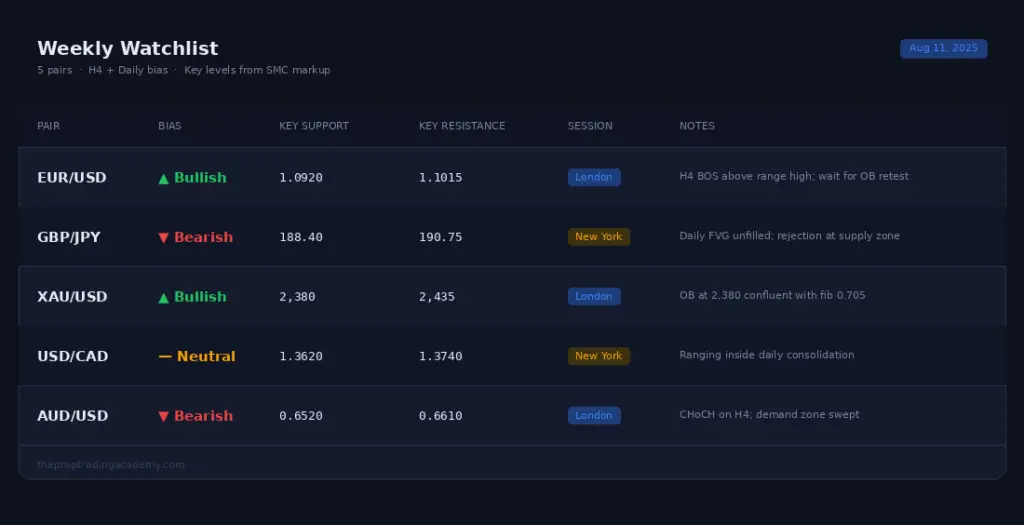
Sunday or Monday evening (30–45 minutes):
- Open D1 charts for every pair on your master list. Mark the current market structure. If structure is unclear or choppy, that pair is off the weekly list.
- Identify key levels on each remaining pair. Mark draw-on-liquidity targets: previous week high/low, equal highs/lows, and untapped order blocks or fair value gaps.
- Check for high-impact news events. Open your economic calendar and note any events that could disrupt your focus pairs.
- Check correlation between your weekly focus pairs. If three of your four weekly picks are all USD-quote pairs, acknowledge the concentration.
- Write your weekly plan. List your 3–5 weekly focus pairs, the bias, the key levels, and the session you plan to trade them in.
The quality of our focus mediates the quality of our access to intuition and prior learning.
Daily pre-session (10–15 minutes):
- Open H4 and H1 charts for your weekly focus pairs only. Is price approaching any of your marked levels today?
- If yes: that pair goes on your session active list. Identify your entry trigger, stop loss placement, and take-profit target before the session opens.
- If no: no trade today. Close the charts and protect your capital — and your psychology — for tomorrow.
This routine takes less than an hour per week. The discipline it creates is worth more than any indicator, signal service, or strategy course.
What mistakes should traders avoid when building a trading watchlist?
We’ve mentioned a number already but we want to highlight those that you need to avoid.
Watching too many pairs without deep knowledge of any
A watchlist of 25 instruments where you cannot name the average daily range, typical spread, or best trading session for any of them is not a watchlist. It is a screensaver. The result: entries based on “it looks like it’s moving” instead of a backtested edge.
Never rotating pairs based on current structure
Some traders set their watchlist once and never change the weekly focus. But market structure is dynamic. GBP/USD might trend cleanly for three weeks and then enter a 100-pip range. During that range-bound period, it does not belong on your weekly focus list. The master list is permanent; the weekly list is conditional.
Chasing exotic pairs or volatile instruments for excitement
USD/TRY has exciting 200+ pip daily ranges. It also has 20+ pip spreads, thin liquidity, and gap risk that can bypass your stop loss entirely. In a prop firm challenge, one exotic trade gone wrong can wipe out two weeks of careful, disciplined gains. Excitement is not edge.
Ignoring correlation between watchlist pairs
If your weekly focus list contains EUR/USD, GBP/USD, and AUD/USD, you have three positions that are functionally one bet. Review correlation before every weekly plan.
Treating the watchlist as static instead of as a daily filter
Your master list is relatively permanent. Your weekly focus list changes every Sunday. Your session active list changes every day. A watchlist is not a list you make once — it is a filtering system you run continuously.
Your watchlist is your first edge
Most traders spend months searching for the perfect entry strategy. However, they often overlook the step that comes before all of that: deciding which financial instruments to trade and which to ignore.
A high-quality watchlist eliminates an entire category of losses — the ones that come from trading unfamiliar pairs during the wrong session, stacking correlated positions without realizing it, or entering a pair whose spread silently eats half your profit target.
So, build your trading master list with care. Review your weekly focus every Sunday. Narrow to 1–2 session-level setups before each session opens. And when your active list is empty (i.e., when no pair has a valid setup at your levels) close the charts and wait.
That becomes your time to build your trading watchlist again.
Ready to become a consistently funded trader?
Building a disciplined watchlist is one piece of the puzzle. Knowing how to read market structure, identify institutional order flow, and manage risk across a full challenge is what separates traders who pass from traders who keep restarting.
At The Prop Trading Academy, Coach Aly helps aspiring traders build the complete skill set: from watchlist construction to SMC-based entries to the psychological discipline that makes everything else work.
Book a free Discovery Call to discuss your trading goals, review your current watchlist and strategy, and find out whether the mentorship program is the right fit for you.
Frequently asked questions
What is a trading watchlist?
A trading watchlist is a curated shortlist of financial instruments that a trader actively monitors for potential setups. For prop firm traders, a focused watchlist is critical because strict drawdown rules punish every unfocused, impulsive trade. A well-structured watchlist typically contains 6–10 instruments on a master list, narrowed to 3–5 weekly and 1–2 per session.
How many pairs should a beginner forex trader watch?
Beginners should start with a master watchlist of 5–7 major forex pairs: EUR/USD, USD/JPY, GBP/USD, AUD/USD, USD/CAD, NZD/USD, and optionally USD/CHF. The goal is to learn each pair’s personality deeply enough that you can read its price action without guessing.
What is the best watchlist for a prop firm challenge?
The best prop firm watchlist prioritizes pairs with tight spreads, clean market structure, and alignment with your trading session. For most evaluation accounts, a master list of EUR/USD, GBP/USD, USD/JPY, AUD/USD, USD/CAD, and XAUUSD covers the major sessions. Avoid exotic pairs — their wide spreads directly eat into your profit target.
What is currency correlation and why does it matter for my watchlist?
Currency correlation measures how closely two pairs move together, from +1 (identically) to -1 (opposite directions). Trading two highly correlated pairs in the same direction effectively doubles your directional exposure, which can cause both trades to lose simultaneously during a single event.
How often should I update my trading watchlist?
Your master list (6–10 instruments) should change slowly — perhaps once a quarter. Your weekly focus list (3–5 pairs) should be reviewed every Sunday or Monday. Your session active list (1–2 pairs) updates daily based on which weekly focus pairs have price approaching your pre-marked levels.
Can I use a stock screener to build a forex watchlist?
Stock screeners are designed for equities. Forex traders use chart platforms like TradingView to visually review market structure, and correlation tools on Myfxbook or broker platforms. The final selection should be based on your strategy fit, session alignment, and backtesting data.
What is the difference between a watchlist and a trading plan?
A watchlist is one component of a trading plan — the part that answers “which instruments am I monitoring?” A complete trading plan also covers your entry criteria, exit rules, risk per trade, position sizing, session schedule, and journaling process.
How do I know when to remove a pair from my watchlist?
Remove a pair from your weekly focus list when it loses structural clarity. Consider removing from your master list if your backtesting shows consistently poor performance over 50+ trades. Removal is not permanent — you can re-add when conditions change.