

How to Create a Daily Trading Routine for Consistent Results
Quick Answer
A daily trading routine is a structured sequence of preparation, execution, and review tasks that a trader completes every session. It removes guesswork, reduces impulsive trades, and builds the consistency that prop firm evaluations test. Traders who follow a documented routine outperform reactive traders because their process stays the same regardless of whether the last trade won or lost.
Key Takeaways
- A daily trading routine has three phases: pre-market preparation, active session execution, and post-session review.
- Execution means following your plan with predefined entries, stops, and targets then stopping when criteria are met.
- The routine itself creates the edge. Strategy gives you a setup. Routine gives you the discipline to execute it the same way every time.
A trader with a profitable strategy and no routine will underperform a trader with an average strategy and a disciplined process. This is one of the most consistently documented findings in trading psychology research.
The reason is straightforward. Without a routine, every session starts from zero. You sit down, open the chart, and make decisions based on whatever you happen to notice. Some days you prepare. Some days you don’t.
That inconsistency makes it impossible to identify what’s working. If you don’t repeat the same process, you can’t measure it. And if you can’t measure it, you can’t improve it. That’s precisely what we’ll break down in this article.
Why most traders lose without a daily trading routine
Data from Trader’s Second Brain, drawn from over 8,400 traders with 90+ days of trading data, found that 31% of traders who actively journal are net profitable. Academic studies put that number between 3% and 15%. The gap is not strategy. It’s process discipline.
A routine does three things that reactive trading cannot:
| What a routine does | What reactive trading does |
|---|---|
| Forces you to define your bias before the session opens | Lets you form opinions after the chart is already moving |
| Sets rules for position sizing and risk before emotions are involved | Adjusts risk on the fly based on recent wins or losses |
| Creates a feedback loop through daily review | Repeats the same mistakes without documentation |
Prop firm challenges expose the gap between traders who have a routine and those who don’t. The rules require steady, repeatable execution. One emotional session without preparation can breach a drawdown limit and end an evaluation.
The three phases of a trading day
Every effective trading routine follows the same arc: prepare, execute, review. The specific tasks within each phase change depending on your strategy, time zone, and session. The sequence doesn’t.
Phase 1 happens before you open a trade. Phase 2 happens while the session is live. Phase 3 happens after you close the platform. Skip any phase and the routine breaks.
The rest of this article walks through each phase in detail with specific checklists you can adapt to your own setup.
Phase 1: Pre-market preparation (15-30 minutes)
This is the phase most traders skip. It’s also the phase that determines whether the rest of your session will be structured or chaotic.
Pre-market preparation is not chart analysis. It’s context setting. You’re answering one question: what is the market likely to do today, and how does my strategy fit into that?
Step 1: Check the economic calendar
Open your economic calendar before you open a chart. ForexFactory, Investing.com, or your broker’s built-in calendar all work.
You’re looking for three things:
High-impact news events scheduled during your trading session. Interest rate decisions, NFP, CPI, GDP – these create volatility spikes that can invalidate technical setups.
Currency-specific events that affect the pairs you trade. If you trade XAUUSD and there’s a Federal Reserve speech at 2:00 AM PHT, that matters.
Yesterday’s unresolved events. Did a news release yesterday create a move that hasn’t retraced? Is there a gap that hasn’t filled?
Ito 'yung pinaka-common mistake na nakikita ko sa students ko - dumederetso sa chart, walang alam kung may NFP pala in two hours. Tapos nagulat kung bakit na-stop out. Five minutes checking the calendar saves you from one trade that could blow your whole challenge.
Step 2: Mark higher-timeframe structure
Before dropping to your execution timeframe, read the daily and 4-hour charts on the pairs you trade. You’re building a directional bias, not looking for entries.
Mark these elements:
- Key support and resistance levels on the daily chart.
- Current market structure. Is the daily chart in a clear uptrend, downtrend, or ranging?
- Unfilled imbalances. If you trade Smart Money Concepts, identify Fair Value Gaps, order blocks, or liquidity pools on the 4H and daily timeframes.
This step takes 5-10 minutes per pair. Keep it focused. You’re establishing context so that when you drop to the 15-minute or 5-minute chart, you already know where the higher-timeframe magnets are.
Step 3: Define your session plan
Write this down. Not in your head. On paper or in your journal app.
Your session plan answers five questions:
- What is my directional bias?
- Where are my zones of interest?
- What confirmation do I need to enter?
- What is my maximum risk per trade?
- What would make me sit out today?
That fifth question is the most important. A session plan is not just a plan for when to trade. It’s a plan for when not to trade.
A sample pre-market checklist
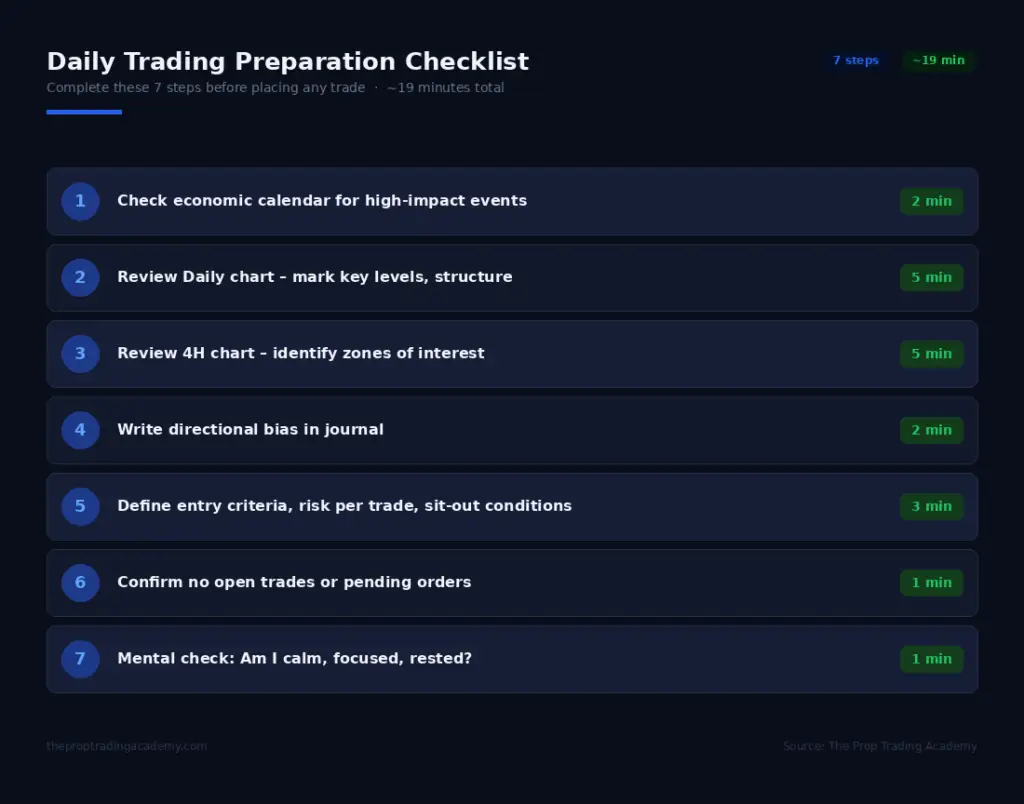
Phase 2: Session execution
Preparation sets the stage. Execution is where the plan meets the market.
The key principle: your job is not to predict what the market will do. Your job is to follow the plan you wrote during Phase 1 and execute it without improvisation.
Wait for your setup
The single most common execution mistake is forcing a trade because you “feel like” the market should move.
You defined your zones of interest. You defined your confirmation criteria. Now you wait. If price never reaches your zone, or reaches it without giving confirmation, the correct action is no trade.
Most professional traders spend more time waiting than trading. A well-structured session might produce one to three opportunities. Some sessions produce zero.
Consider Paolo, a trader from Cebu on Day 18 of a $50,000 FTMO challenge. He’s up 5.2% with a 6% target remaining. His daily loss limit is 5%. He runs his pre-market checklist and finds no clear structure on XAUUSD and a CPI release at 8:30 PM PHT. His plan says: sit out during high-impact news if no setup formed before the release.
The undisciplined version forces a trade before CPI, gets caught in the spike, and loses 2.3% in eight minutes. The version with a routine closes the laptop and comes back tomorrow with his account intact.
Follow your rules for the active session
One trade at a time unless your plan explicitly allows multiple positions. Most prop firm challenges penalize overlapping risk.
Set your stop loss before you enter. Not after. Not “mentally.” An actual stop loss on the platform.
Don’t move your stop loss further from entry. Widening a stop after entry is managing emotions, not managing risk.
Hit your daily limit and stop. Whether a profit target or a loss limit, when you hit the number, the session is over. Close the platform.
One pattern I've seen after mentoring hundreds of traders: the best sessions are usually the boring ones. You wait, you take one clean trade, you close. The worst sessions are the ones where the trader is "in the zone" and keeps going. That feeling is almost always overconfidence, not skill.
Phase 3: Post-session review (15-20 minutes)
This is the phase that compounds. Preparation keeps you disciplined today. Review makes you better tomorrow.
Most traders close a session and walk away. Winners close a session and debrief.
A 2019 study in the Journal of Behavioral Finance found that traders who systematically reviewed past trades improved risk-adjusted returns by 12-18% over 12 months. A separate analysis by TradesViz, covering over 500,000 trades, showed that traders who logged at least 90% of trades maintained win rates roughly 8 percentage points higher than those who logged fewer than half.
Keep a trading diary - write down your reasons for entering and exiting every trade. Look for repetitive patterns of success and failure.
What to record after every session
Your post-session journal should capture five categories:
1. Trade data. Pair, direction, entry, SL, TP, lot size, result. Your platform can auto-fill most of it.
2. Setup quality. Did the trade match your pre-session plan? Rate 1-3: off-plan, partially aligned, textbook.
3. Rule adherence. Did you follow every rule? Simple yes/no checklist.
4. Emotional state. How did you feel before, during, and after? This data reveals the patterns behind most losses.
5. One improvement for tomorrow. Not five. One. “Wait for 15M confirmation instead of entering on 5M” is specific. “Be more disciplined” is not.
How to do a weekly review
Daily reviews capture what happened. Weekly reviews reveal why.
Every weekend, spend 30-45 minutes reviewing the full week:
- How many trades followed the plan versus deviated? If more than 30% were off-plan, the problem isn’t strategy – it’s execution discipline.
- Win rate on A-grade setups versus C-grade? Most traders find their best setups win at 55-65%, while improvised trades win at 30-40%.
- Did any emotional pattern repeat? Two revenge trades Wednesday. Overtrading Friday after winning Thursday. These patterns only emerge from consistent documentation.
- Are you improving on last week’s one-thing? If yes, pick a new focus. If no, keep it another week.
What does a weekly review look like?
You don’t need expensive software. A spreadsheet works. A notebook works. The best journal is the one you actually fill out.
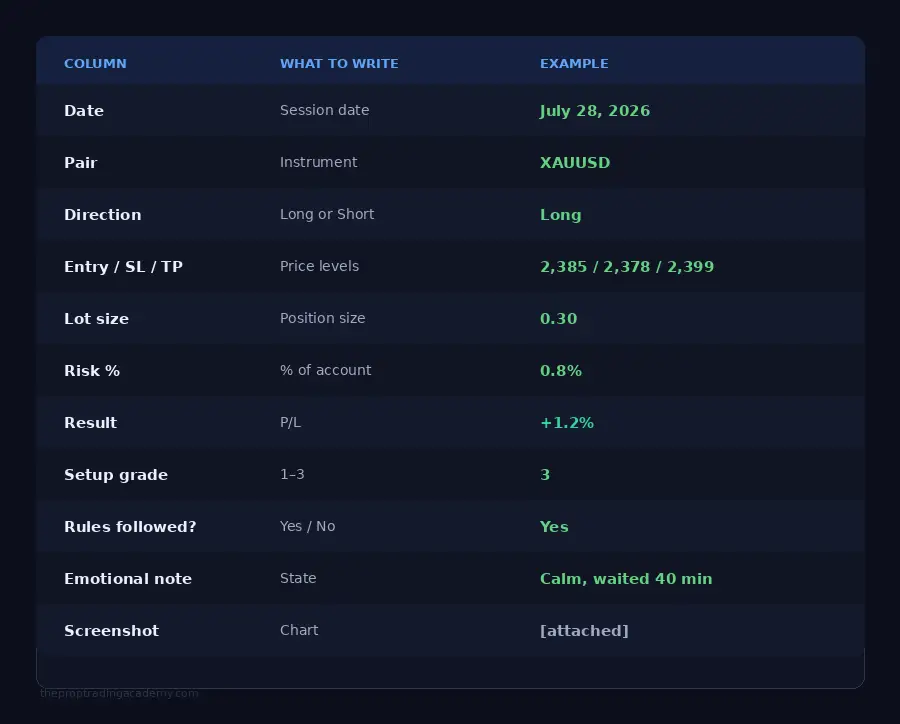
The rule of the thumb is to keep it simple, so that you remain committed to reviewing your trades.
How to map your routine to Philippine time
Forex sessions don’t align to a 9-to-5 schedule anywhere, especially not in the Philippines. Understanding when high-volume windows occur in PHT is essential for building a routine that produces tradeable setups.
Our forex market sessions tool can help you visualize your trading routine. So, make sure to use this tool.
Forex sessions in Philippine Standard Time
| Session | PHT hours | Characteristics |
|---|---|---|
| Sydney | 5:00 AM – 2:00 PM | Low volume. AUD and NZD pairs move; most majors quiet. |
| Tokyo | 8:00 AM – 5:00 PM | Moderate volume. JPY pairs active. Range strategies. |
| London | 3:00 PM – 12:00 AM | Highest volume. EUR, GBP, and gold see major moves. |
| New York | 9:00 PM – 6:00 AM | Second-highest volume. USD pairs and gold most active. |
| London-NY overlap | 9:00 PM – 12:00 AM | Peak liquidity. Tightest spreads. Largest displacements. |
Times shift by one hour during US and UK Daylight Saving Time. Verify with your broker.
Three routine templates for Filipino traders
Not every Filipino trader has the same schedule. Here are three realistic templates:
Template A: Afternoon-evening trader (London session)
Best for: day-shift workers, students, anyone available from late afternoon.
| Time (PHT) | Activity |
|---|---|
| 2:00 PM – 2:30 PM | Pre-market prep: calendar, daily/4H review, session plan |
| 3:00 PM – 6:00 PM | Active session: London open, monitor for setups |
| 6:00 PM – 6:20 PM | Post-session review and journal |
Catches the London open when most SMC-based setups trigger. Done before dinner.
Template B: Night trader (London-New York overlap)
Best for: freelancers, remote workers, or those who prefer highest-volume window.
| Time (PHT) | Activity |
|---|---|
| 8:00 PM – 8:30 PM | Pre-market prep: calendar, chart review, session plan |
| 9:00 PM – 12:00 AM | Active session: London-NY overlap, highest volatility |
| 12:00 AM – 12:20 AM | Post-session review and journal |
The overlap window is where spreads are tightest and displacements largest. Prime window for XAUUSD.
Template C: Morning trader (Asian session)
Best for: OFWs in Middle Eastern time zones, early risers, JPY/AUD pair traders.
| Time (PHT) | Activity |
|---|---|
| 7:30 AM – 8:00 AM | Pre-market prep: calendar, chart review, session plan |
| 8:00 AM – 11:00 AM | Active session: Tokyo session, JPY/AUD pairs |
| 11:00 AM – 11:20 AM | Post-session review and journal |
Lower volume means tighter ranges. Works best for range-based strategies or building screen time while employed.
Consider Rina, a Filipina nurse in Jeddah working 7:00 AM – 3:00 PM Saudi time. When she finishes at 3:00 PM KSA, it’s 8:00 PM PHT – exactly when the London-NY overlap begins. She preps, trades the overlap from 3:30-7:00 PM KSA, journals, and is in bed by 8:00 PM KSA. A structured, sustainable routine without quitting her job.
Common mistakes that break a routine
Building a routine is the first challenge. Maintaining it is the harder one.
Skipping preparation after a winning streak
Three winning days and preparation feels unnecessary. You skip the calendar, skip the HTF review, and trade from memory. This is overconfidence bias. Research by Terrance Odean at UC Berkeley shows traders increase position sizes and frequency after gains – precisely the behavior that increases drawdown risk.
The routine protects you from yourself during periods when you feel least like you need protection.
Journaling only winning trades
If your journal only contains winners, it’s a highlight reel, not a diagnostic tool. The losses are where improvements live. Document every trade. Especially the ones you don’t want to look at.
Trading outside your session window
Your routine is tied to a specific session for a reason. That session produces the volume, volatility, and price behavior your strategy requires. Trading at random hours because you’re bored is how off-plan trades happen.
One clean session per day is enough.
Overcomplicating the routine
A 90-minute pre-market ritual analyzing six pairs across eight timeframes with four indicators is not a routine. It’s a procrastination mechanism.
Effective routines are short, focused, and repeatable. Twenty minutes of preparation, a defined session window, fifteen minutes of review. If your routine takes longer than your actual trading session, simplify it.
May student ako dati, gumawa ng Excel file na 47 columns para sa journal niya. Every trade, isang oras ang review. After one week, hindi na siya nag-journal. The routine has to be something you'll actually do every single day, even when you're tired. Kung hindi mo kayang gawin consistently, hindi routine 'yun - assignment 'yun.
The compounding effect of 90 days
A single day of following a routine produces nothing remarkable. Ninety consecutive days transforms a trader’s performance in measurable ways.
Week 1-2: The routine feels mechanical. You’re checking boxes. The benefit isn’t visible. This is where most traders quit.
Week 3-4: You notice patterns. Tuesdays are weakest. Your XAUUSD longs win at 61% but shorts at 38%. You overtrade after 10:00 PM PHT. These discoveries are impossible without documented data.
Month 2: You’ve adjusted. You stopped trading Tuesdays. Reduced XAUUSD shorts. Set a hard stop time at 10:30 PM. Win rate and expectancy improve because you’re cutting the behaviors that cost money.
Month 3: The routine runs on autopilot. Your journal contains enough data to calculate true expectancy per setup type. You know your edge and trade it mechanically.
This is the trajectory that gets traders funded – and keeps them funded.
Market analysis is not the path to consistent results. It will not solve the trading problems created by lack of confidence, lack of discipline, or improper focus.
Douglas spent his career arguing that the gap between analytical ability and actual results is almost entirely explained by process and mindset. A daily routine is how that process gets implemented at the operational level.
Your complete daily trading routine template
Copy this template and adapt it to your session, pairs, and strategy. The structure stays the same. The specifics are yours.
Pre-market (15-30 min before session)
| # | Task |
|---|---|
| 1 | Check economic calendar for high-impact events |
| 2 | Review Daily chart – mark support/resistance, structure |
| 3 | Review 4H chart – identify zones of interest (OBs, FVGs, liquidity) |
| 4 | Write directional bias in journal |
| 5 | Define entry criteria, risk per trade, sit-out conditions |
| 6 | Confirm no leftover positions or pending orders |
| 7 | Mental self-check: rested, calm, focused? |
Active session
| # | Rule |
|---|---|
| 1 | Wait for price to reach your zone – don’t chase |
| 2 | Confirm entry on execution timeframe before entering |
| 3 | Set stop loss before entering the trade |
| 4 | Risk no more than your per-trade limit (0.5-1%) |
| 5 | Don’t move stop loss away from entry |
| 6 | If daily loss limit or profit target is hit, stop trading |
| 7 | Maximum trades per session: 2-3 |
Post-session (15-20 min after session)
| # | Task |
|---|---|
| 1 | Log every trade: pair, entry, SL, TP, lot size, result |
| 2 | Rate each trade’s setup quality (1-3) |
| 3 | Check rule adherence |
| 4 | Note emotional state before, during, after each trade |
| 5 | Screenshot each trade with entry/exit marked |
| 6 | Identify one specific improvement for tomorrow |
| 7 | Update drawdown tracker (prop firm accounts) |
Weekly review (30-45 min on weekends)
| # | Task |
|---|---|
| 1 | Calculate win rate, average R, and expectancy for the week |
| 2 | Compare A-grade setups vs off-plan trades |
| 3 | Identify repeating emotional or behavioral patterns |
| 4 | Assess progress on last week’s one-thing improvement |
| 5 | Set next week’s single focus area |
| 6 | Review remaining drawdown and challenge timeline |
Final thoughts
A daily trading routine is the structural foundation that makes traders see consistent results possible over months and years.
You don’t need a complex system. What you need is a simple routine you can keep doing every day. That cycle, repeated consistently, will tell you more about your trading than two years of unstructured screen time.
The traders who pass prop firm challenges and keep funded accounts are those who do the same boring things every single day and let the compounding effect of consistent process do the work.
So, start today with your daily trading routine. Open a spreadsheet, write tomorrow’s session plan, and commit to reviewing it after the session. The routine begins the moment you decide it does.
Book a free Discovery Call to discuss your trading routine, identify where your process is breaking down, and find out whether the mentorship program is the right fit for where you are right now.
Frequently asked questions
How long should a daily trading routine take?
A complete routine takes 3 to 5 hours including active chart time. Preparation takes 15-30 minutes. Post-session review takes 15-20 minutes. The active session lasts 2-4 hours. The routine itself adds roughly 45 minutes to your trading day.
Do I need a routine if I only trade part-time?
Part-time traders need a routine more than full-time traders. When trading time is limited, every session carries more weight. A part-time trader following a 20-minute prep, 2-hour session, 15-minute review cycle will outperform a part-timer staring at charts without structure.
What's the best time to trade forex in the Philippines?
The London-New York overlap from approximately 9:00 PM to 12:00 AM PHT produces the highest volume and tightest spreads for major pairs and gold. The London open from 3:00 PM to 6:00 PM PHT is the second-best window.
Should I trade every day?
No. Your routine should include criteria for sitting out. Days with no clear structure, high-impact news during your session, or days when you’re exhausted are valid reasons to skip.
What should I write in a trading journal?
At minimum: date, pair, direction, entry/stop/target levels, lot size, risk percentage, result, setup quality rating, whether you followed your rules, and emotional state. The most valuable entries include a chart screenshot with entry and exit marked.
How do I stay consistent when I keep losing?
Use your journal data. Check whether losses came from A-grade setups (temporary drawdown, normal) or off-plan trades (self-inflicted). If A-grade setups are losing, reduce size and keep executing. If off-plan trades are the problem, tighten adherence to your routine.
How does a routine help pass a prop firm challenge?
Prop firm challenges test process, not prediction. The rules reward traders who manage risk consistently and punish those who swing between aggressive and cautious behavior. A routine forces you to define risk before each session and review performance daily.
What's the difference between a trading plan and a trading routine?
A trading plan defines your strategy – what setups you trade, risk parameters, pairs. It changes rarely. A trading routine is the daily process to execute that plan. The plan is the “what.” The routine is the “how” and “when.”