
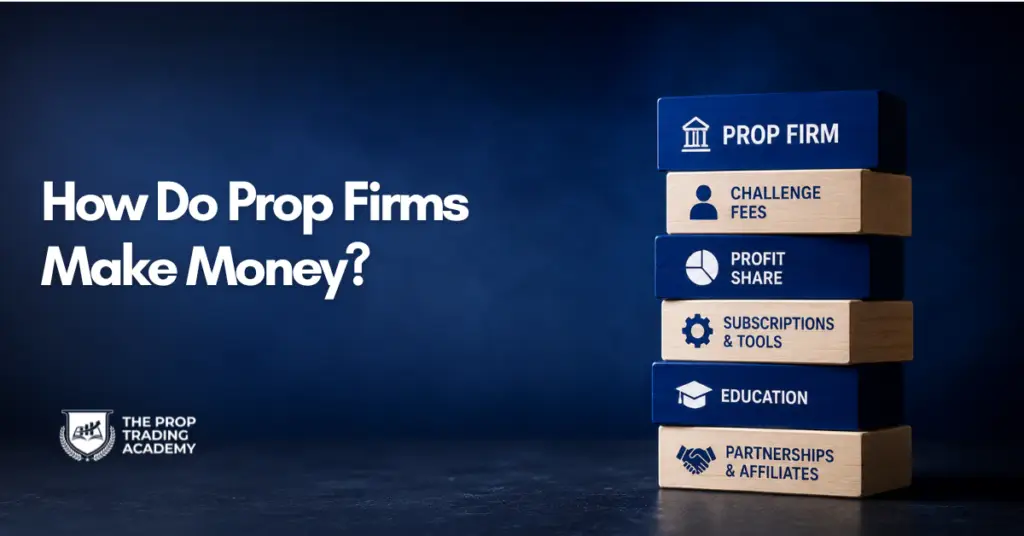
How Do Prop Firms Make Money? Understanding Their Business Model
Quick Answer
Prop firms make money primarily through challenge fees paid by traders who attempt funded account evaluations. With industry pass rates between 5% and 15%, the majority of fees become direct revenue. Secondary income comes from the firm’s share of profit splits, reset and retake fees, and copying successful traders’ signals into live market positions.
Key Takeaways
- Challenge fees are the primary revenue source. With 85–95% of traders failing evaluations, these fees carry high profit margins.
- Profit splits (the firm’s 10–30% cut) are secondary income. The firm earns most of its money before a trader ever gets funded.
- Most retail prop firms run on simulated (demo) accounts. Payouts come from the firm’s operating revenue, not live market profits.
Between 85% and 95% of traders who buy a prop firm challenge will fail it.
It’s not because the market was unfair or because the strategy was wrong. Most fail because they break a risk rule within the first week.
That stat filters out most people. But it also reveals something useful: the business model itself tells you exactly what the firm values, what it rewards, and where most traders go wrong. Understanding the prop firm’s business model helps you stop guessing moving forward.
The math behind the model
A $100,000 funded account with an 80/20 profit split sounds generous. The trader keeps $4,000 out of every $5,000 in profit. The firm keeps $1,000.
So how does the firm survive on $1,000?
Volume.
Thousands of traders purchase challenges every month. The vast majority fail. According to FPFX Technology’s analysis of over 300,000 accounts across 10 firms, only about 14% of traders pass a challenge. Just 7% ever receive a payout.
For every 100 traders who buy a $250 challenge, the firm collects $25,000 in fees. Roughly 7 of those traders will reach a payout. The other 93 fees ($23,250) become near-pure revenue, because the evaluation runs on a demo server with minimal infrastructure cost.
That ratio is the engine of the prop firm business model.
I don’t say this to discourage anyone. I say it because understanding the math changes how you approach the challenge. When you realize the firm’s business depends on most traders failing, you stop seeing the rules as obstacles. You start seeing them as the exact filter you need to pass through. The traders who treat risk management as a suggestion are funding the payouts of the traders who treat it as law.
The four revenue streams of a retail prop firm
Not every prop firm earns money the same way. But the model across the industry breaks down into four categories, roughly in order of contribution to total revenue.
1. Challenge and evaluation fees
Every trader who attempts a challenge pays an upfront fee, regardless of outcome. This is the largest single revenue stream.
| Account size | Typical challenge fee (2026) | Pass rate (industry avg.) |
|---|---|---|
| $10,000 | $80–$130 | 5–15% |
| $25,000 | $150–$250 | 5–15% |
| $50,000 | $250–$350 | 5–15% |
| $100,000 | $400–$550 | 5–15% |
| $200,000 | $800–$1,100 | 5–15% |
Challenges run on simulated environments. The firm’s cost per evaluation is primarily server hosting and customer support. The capital displayed in your account is not real money at risk during the evaluation.
One industry estimate puts the total addressable market for evaluation fees between $2 billion and $4 billion annually worldwide.
2. Reset and retake fees
When a trader fails, most firms offer a discounted retake (typically 10–20% off the original fee). Some also sell “reset” options mid-challenge, allowing a restart without losing the slot.
This creates a recurring revenue loop. The same trader may purchase two, three, or five attempts before passing or moving on.
According to FPFX Technology’s data, the average trader who eventually passes does so on roughly their third attempt. The firm collects two to three fees before a single payout obligation is created.
3. Profit splits (the firm’s share)
Once a trader is funded, the firm retains 10–30% of profits. At an 80/20 split, the firm’s share of a $5,000 monthly profit on a $100K account is $1,000.
Real revenue. But smaller and less predictable than challenge fees. Only a fraction of funded traders remain consistently profitable. Many lose their accounts within weeks of funding.
Walk through what this looks like in practice.
Paolo from Cebu passes his $50,000 challenge on his second attempt. He paid $300 twice ($600 total). In his first funded month, he earns 4% ($2,000). The firm keeps 20%: $400.
The firm already collected $600 in challenge fees. The ongoing profit split is a bonus. The fees covered the firm’s economics before Paolo ever got funded.
4. Data, signal copying, and broker partnerships
This is the revenue stream most traders don’t know about.
Some firms use their top-performing funded traders as a data source. When a trader demonstrates a strong, consistent profit factor over several months, the firm may begin copying that trader’s signals into live market positions using the firm’s own capital.
The trader’s demo environment becomes a signal-generation engine. The firm profits from the live positions. Reputable firms disclose this practice in their terms of service.
Additional revenue from this tier includes:
- Spread markup and commissions: Some firms add a small markup to spreads or charge per-lot commissions.
- Broker and liquidity provider partnerships: Firms that route order flow through a broker may earn rebates based on trading volume.
- Affiliate and referral programs: Many firms pay content creators $50–$150 per referred challenge purchase. This is a cost center funded by the high margins on challenge fees.
When I explain this to my students, the light bulb moment is always the same: “So the firm doesn’t need me to be profitable to make money?” Exactly. The firm’s survival depends on volume. Your success is a bonus for them. A good outcome, but not the one their cash flow relies on. That’s not a reason to avoid prop firms. It’s a reason to go in with open eyes.
Demo-based vs. live-capital models: where your money actually goes
Do prop firms trade with real money or simulated accounts?
Most retail forex and CFD prop firms in 2026 operate on a demo-based (simulated) model.
How the simulated model works
During the evaluation, your account is a demo. No real money is placed in any market. You’re trading virtual capital against a price feed that mirrors live conditions.
Here’s the part that surprises most traders: for many firms, the funded account is also simulated.
The firm pays your profit split from its operating revenue (the pool of challenge fees collected from all traders), not from profits generated by your trades in live markets. This model is sometimes called a “B-book” or “internalized” model.
How the live-capital model works
A smaller number of firms route funded trader positions into real markets through a liquidity provider. The firm takes genuine market exposure. Profits and losses are real.
Firms operating this model include those that evolved from traditional brokerages (like Axi Select) or institutional prop firms that allocate real capital.
The hybrid model
Some firms combine both approaches. Evaluations are simulated. Funded accounts start on demo. But when a trader demonstrates sustained profitability over months, the firm mirrors that trader’s signals into live positions.
The trader stays on demo. The firm copies the edge into real markets.
This is the “alpha harvesting” model that has gained traction since 2024.
| Model | Evaluation | Funded account | Where payouts come from |
|---|---|---|---|
| Simulated (B-book) | Demo | Demo | Challenge fee revenue pool |
| Live-capital (A-book) | Demo | Live market | Actual trading profits |
| Hybrid | Demo | Demo \u2192 live mirroring | Challenge fees + live market profits |
Why does the model matter to you?
A firm’s financial health depends on which model it uses.
A simulated-model firm needs steady challenge fee volume to fund payouts. If new purchases slow down while funded trader payouts increase, the firm faces a cash flow squeeze. This is one reason 80–100 prop firms shut down in 2024, according to Finance Magnates Intelligence. Many had built models entirely dependent on fee volume.
A live-capital firm carries different risk: if funded traders lose money in real markets, the firm absorbs the loss. But the upside is genuine market revenue, making the business less dependent on a constant flow of new challenge purchases.
The defining characteristic that separates the consistent winners from everyone else is this: the winners have attained a mindset that allows them to remain disciplined, focused, and confident in spite of adverse conditions.
How much money do successful prop firms make?
FTMO is the most transparent case study. According to Finance Magnates:
- 2023 turnover: approximately $213 million, with EBITDA near $100 million
- 2024 revenue: approximately $329 million (53% year-over-year growth), with net profit of roughly $62.5 million
- Cumulative payouts to traders: over $450 million since launch in 2015
Even after paying out hundreds of millions to funded traders, challenge fee volume generates enough revenue to sustain the business and produce significant profit.
Apex Trader Funding, a major futures-focused firm, has reported distributing over $598 million in cumulative payouts since 2022.
The industry as a whole is estimated at around $20 billion in value, with over 2,000 firms operating globally as of 2025.
What separates a sustainable firm from one at risk of collapse
80–100 prop firms closed in 2024. When MetaQuotes pulled platform licenses from several operators, firms vanished within weeks.
The firms that collapsed shared common traits. Recognizing those traits helps you avoid putting money into a firm that won’t be around to pay you.
Signs of a financially healthy firm
You can easily identify if a prop firm business is financially healthy by looking into these details:
- Diversified revenue. The healthiest operators generate income from multiple streams: challenge fees, profit splits, signal copying into live markets, broker partnerships, and scaling programs. If new challenge purchases slow down for one quarter, diversified firms survive.
- Transparent payout history. Firms that share real numbers are signaling that their cash flow can handle the financial obligations.
- Regulated or regulator-adjacent. Full regulation of prop firms is still evolving. But firms that hold brokerage licenses, partner with regulated brokers, or voluntarily comply with financial reporting standards are harder to collapse overnight.
- Conservative scaling. Firms that offer 90% or 100% profit splits with minimal verification are often subsidizing those payouts with unsustainable fee-to-payout ratios. If the math doesn’t work at scale, the firm’s runway shortens with every successful payout.
Red flags to watch for
| Red flag | Why it matters |
|---|---|
| No verifiable payout history | You can’t confirm the firm pays its traders |
| Aggressive discounts (70–80% off) | Signals desperation for fee volume |
| No clear terms on demo vs. live execution | The firm may not want you to know the model |
| Sudden rule changes after funding | May indicate cash flow pressure |
| No company registration or identifiable founders | Accountability disappears if the firm does |
I always tell my students: before you spend ₱15,000 on a challenge, spend 30 minutes researching the firm. Check Trustpilot. Search Reddit. Look for payout proof from real funded traders, not from the firm’s own marketing page. Ang dami kong nakitang students na nag-lose ng pera sa firms na nag-close after two months. That fee could have gone to a firm with three years of documented payouts.
Why the business model benefits disciplined traders
Reading about failure rates and fee-dependent revenue might feel discouraging.
But the model is not working against you. It’s working against traders who can’t manage risk. That distinction matters.
The firm’s rules (daily loss limits, maximum drawdown, consistency requirements) exist because the firm’s profitability depends on filtering out traders who blow accounts. Every rule is a screening mechanism. Traders who internalize the rules as part of their process are exactly what the firm wants: low-risk, consistent performers who generate profit-split revenue over months and years.
Consider Rina from Davao.
She purchased a $50,000 challenge for $300. Failed her first attempt in week two. She breached the 5% daily loss limit after revenge trading a losing London session.
She reviewed her journal. Identified the pattern. Purchased a retake for $250.
On her second attempt, she traded the same SMC-based XAUUSD strategy but capped her risk at 0.5% per trade and walked away after two trades per session. She passed Phase 1 in 18 trading days and Phase 2 in 12.
The firm collected $550 in fees from Rina. In her first three funded months, she averaged 3.5% returns. On a $50,000 account at 80/20, that’s $1,400/month to Rina ($4,200 over three months) and $350/month to the firm ($1,050 over three months).
The firm made $1,600 total ($550 in fees + $1,050 in profit share). Rina made $4,200.
Both sides won.
The goal of a successful trader is to make the best trades. Money is secondary.
Common myths about the prop firm business model
Myth: “Prop firms are scams because they profit from failure”
Gyms profit when members don’t show up. Insurance companies profit when you don’t file a claim. Prop firms profit when traders fail challenges.
None of these facts make the business a scam.
The question is whether the firm delivers on its promises to those who succeed. A firm that collects fees, runs a fair evaluation, and pays funded traders on schedule is operating a legitimate business.
Evaluate the firm by its payout track record and not just by the existence of a failure rate.
Myth: “If it’s a demo account, the firm isn’t real”
Most retail prop firms use simulated accounts. That is standard industry practice.
However, the key question is whether the firm pays real money to funded traders. If a firm runs evaluations on demo, funds traders on demo, and still pays out $450 million over 10 years (as FTMO has), the payout is real regardless of the execution model.
The demo-vs-live distinction matters for understanding firm sustainability.
Myth: “The rules are designed to make you fail”
A 5% daily loss limit and 10% maximum drawdown are not unreasonable constraints. Professional fund managers operate under similar or tighter mandates.
The same 5% daily loss limit that trips up an overleveraged trader is invisible to a trader risking 0.5% per position. Traders who perceive the rules as traps typically have a risk management problem, not a rules problem.
Myth: “Only the firm wins”
FTMO has paid out over $450 million. Apex Trader Funding has reported over $598 million in cumulative payouts. Individual traders have documented withdrawals exceeding $100,000 over time.
The payout rate is low. Roughly 7% of all traders who purchase a challenge ever receive a withdrawal, according to FPFX Technology data. But that 7% represents real people receiving real money. The model produces winners. Fewer of them than social media suggests, but real ones.
Loss of discipline is not the problem. Loss of discipline is the result of a problem, and we have to diagnose that problem to figure out how to address it.
What Filipino traders should know about the model
The prop firm business model carries specific advantages for traders based in the Philippines or working abroad as OFWs.
Here are some reasons:.
No geographic restrictions. Most major prop firms accept traders from the Philippines. MetaTrader 4 or 5, cTrader, or the firm’s proprietary platform. Laptop and internet connection. Whether you’re in Quezon City, Jeddah, or Dubai, the opportunity is the same.
Challenge fees are small relative to the opportunity
A $300 challenge fee is roughly ₱17,000. That gives you access to a $50,000 funded account. Funding a personal live brokerage account of the same size would cost ₱2.85 million
Payouts convert favorably
A 3% monthly return on a $50,000 funded account at 80/20 produces $1,200/month for the trader.
At current rates, that’s approximately ₱68,000. That’s more than meaningful supplemental income for a nurse in Manila, a seafarer between contracts, or a freelancer in Cebu.
The prop firm absorbs the downside
If you fail, you lose the challenge fee. You don’t lose savings, emergency funds, or money earmarked for family. Maximum financial exposure is capped at the fee.
Compare that to blowing a ₱50,000 personal trading account. Unfortunately, many Filipino traders have experienced that more than once.
Maraming Filipino traders ang stuck sa cycle na pamilyar sa akin: mag-deposit ng ₱10,000, ma-blow sa loob ng dalawang linggo, mag-deposit ulit. The prop firm model breaks that cycle. Your risk is the fee. Your upside is a funded account in USD. But the model only works if you’ve already built the discipline to pass. Master the process on demo first. The challenge is not the place to learn. It’s the place to perform.
Final thoughts
Prop firms are businesses. They make money by offering a service, pricing it correctly, and maintaining margins that sustain operations.
The challenge fee model works because most traders aren’t ready. That’s data, not cynicism. And it’s also the opportunity.
If you’ve done the work, tested your strategy, and proven you can follow risk management rules without exception, the model tilts in your favor. You pay a few hundred dollars. You receive access to tens of thousands in capital. You keep 70–90% of the profits.
Know the model. Respect the rules. Trade accordingly.
Ready to become a consistently funded trader?
You now understand how the business model works. The next step is building the process that gets you through it.
At The Prop Trading Academy, Coach Aly helps aspiring traders develop the discipline, risk management habits, and strategy execution needed to pass prop firm challenges and stay funded long-term.
Book a free Discovery Call to discuss your trading goals, identify what’s holding you back, and find out whether the mentorship program is the right fit for you.
Frequently Asked Questions
How do prop firms make money if traders keep 80% of profits?
Challenge fees are the primary revenue source, not profit splits. Most retail prop firms collect fees from thousands of evaluation attempts each month. With pass rates between 5% and 15%, the vast majority of fees become direct revenue. The firm’s 20% share of funded trader profits is secondary income. The business model depends on high volume and high failure rates to sustain payouts to the smaller number of traders who succeed.
Do prop firms trade with real money?
It depends on the firm and the model. Most retail forex and CFD prop firms in 2026 operate on a simulated model where funded accounts are demo-based. The firm pays profit splits from operating revenue, not from live market profits. Some firms, particularly those with brokerage licenses, route funded trader positions into live markets. A growing number use a hybrid model: demo accounts for evaluation and initial funding, with live signal mirroring for consistently profitable traders.
Is the prop firm business model a pyramid scheme?
No. A pyramid scheme generates revenue by recruiting new participants who pay existing participants. Prop firms generate revenue from service fees (evaluations) and from profit splits on funded accounts. Traders receive a legitimate service: access to capital and a structured evaluation. The firm doesn’t require traders to recruit others. The high failure rate is a feature of the difficulty, not evidence of fraud.
Why do so many traders fail prop firm challenges?
According to FPFX Technology’s analysis of over 300,000 accounts, the dominant failure causes are behavioral: overleveraging, revenge trading, and drawdown breaches. Most traders violate risk rules within the first week. The evaluation’s profit target (typically 8–10%) against a 5% daily loss limit and 10% maximum drawdown creates a narrow margin of error. Traders who risk more than 1–2% per trade have very little room to recover from consecutive losses.
How much do prop firms pay out to traders?
Payout amounts vary by firm size and trader performance. FTMO has reported paying out over $450 million to traders since its founding in 2015. Apex Trader Funding has reported over $598 million in cumulative payouts since 2022. Individual payouts depend on account size, profit percentage, and the firm’s profit split ratio. On a $100,000 account with an 80/20 split, a 5% monthly return produces $4,000 for the trader and $1,000 for the firm.
Can a prop firm go out of business?
Yes. An estimated 80–100 prop firms closed in 2024, according to Finance Magnates Intelligence. The most common causes were unsustainable fee-to-payout ratios, loss of platform licenses (MetaQuotes terminated several operators), regulatory pressure, and poor financial management. Evaluate a firm’s track record, payout history, company registration, and financial transparency before committing money.
How do I know if a prop firm is financially stable?
Look for published payout data, a multi-year operating history, identifiable founders with public profiles, company registration in a verifiable jurisdiction, and evidence of diversified revenue. Check independent review platforms like Trustpilot, Reddit communities, and Discord servers where funded traders share payout proof. Avoid firms that rely heavily on promotional discounts or offer profit splits that seem too generous to be sustainable.
How is a retail prop firm different from an institutional prop firm?
Institutional prop firms (like Jane Street or Citadel Securities) hire traders as employees, provide real capital, and trade the firm’s own money in live markets. Revenue comes from trading profits. Retail prop firms sell evaluations to external traders, typically use simulated accounts, and generate most revenue from challenge fees. The trader’s relationship with a retail prop firm is that of a customer, not an employee.