
How Long Does It Take to Pass a Prop Firm Challenge?
Quick Answer
Most traders take 3–6 months from their first challenge purchase to receiving a funded account payout. A skilled, disciplined trader can complete a single two-step evaluation in 4–8 weeks, but the industry-wide first-attempt pass rate sits between 5% and 10%. The average trader purchases roughly three challenges before passing or quitting.
Key Takeaways
- A two-step prop firm challenge takes most successful traders 4–8 weeks to complete, but only 5–10% pass on their first attempt — so realistic timelines run 3–6 months including retakes.
- About 70% of challenge failures come from breaching loss limits and not from missing profit targets.
- The average trader spends around $800 across three challenge attempts before getting funded, so treating preparation as a time investment saves both money and months.
Fourteen out of every 100 traders who buy a prop firm challenge will pass it. Of those 14, only half will ever receive a payout. That’s FPFX Technology’s data from over 300,000 accounts across 10 firms as reported by Finance Magnates.
And yet, every week, someone posts a screenshot of a 5-day pass on Facebook like it’s the norm.
So how long does it actually take? If “pass” means hitting the profit target on your evaluation, a well-prepared trader can do that in two to four weeks. If it means real money hitting your bank account from funded trading, three to six months is closer to the truth. And that’s if you pass on the first attempt.
This guide breaks down every phase of that timeline. We’ll show you the numbers and the factors that can speed you up or slow down your prop firm challenge.
What does “passing a prop firm challenge” actually mean?
When most traders say they want to “pass a prop firm challenge,” they picture one thing: hitting the profit target. But the journey from buying a challenge to withdrawing actual profits involves at least five distinct phases, and each one adds time.
Here’s the typical cycle:
Phase 1 — Evaluation
You trade a simulated account under strict rules. The typical two-step model requires hitting a 10% profit target in Phase 1, then a 5% target in the verification phase.
Both phases have daily loss limits (usually 5% of equity) and a maximum drawdown cap (typically 10% from your starting balance). As of 2026, major firms have removed hard time limits on their challenges, but minimum trading day requirements still apply — 4 days per phase at FTMO, 5 at FundedNext.
Phase 2 — Verification
Same risk rules; lower profit target. The firm wants evidence that your Phase 1 results weren’t a lucky streak. This phase often takes longer than Phase 1 because the pressure of “almost being funded” changes how traders behave.
When you succeed this phase, this is typically when you can say “I have passed a prop firm challenge!”
Phase 3 — KYC and account activation
Once you pass, the firm verifies your identity before issuing a funded account. This typically adds 24–72 hours, sometimes longer depending on the firm's processing queue and your documentation.
Phase 4 — Funded trading
Your funded account is live, but you can’t withdraw profits immediately. Most firms require a minimum trading period. That’s often around 14 days or a set number of trading days before you’re eligible for your first payout.
Phase 5 — Payout processing
You request a withdrawal. The processing takes 1–5 business days depending on the firm and payment method (bank wire, crypto, or e-wallet).
When a prop firm successfully pays you, now you can officially say, “I got my payout!”
Add all five phases together. Even in the best-case scenario — passing both evaluation phases on the first attempt, clean KYC, minimum funded trading period, fast payout processing, the floor is roughly six to eight weeks from purchase to money in your account.
Maraming traders na tinuruan ko, ang tingin nila sa “passing” ay yung profit target lang. Pero pag tinanong mo sila, “Kailan ka talaga babayaran?” — walang sagot. Know the full timeline before you start. It changes how you plan your risk, your position sizing, and even which firm you choose.
How long does each phase of the challenge take?
The timeline varies dramatically based on the challenge structure you choose. Here’s what successful traders typically experience at each model, based on 2026 industry data and firm disclosures.
One-step challenges
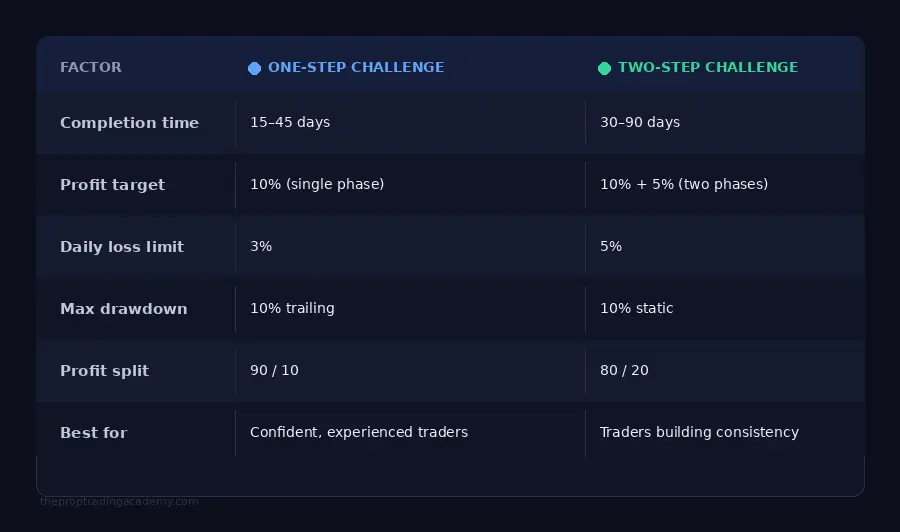
One-step evaluations compress everything into a single phase. You hit one profit target (usually 10%), stay within tighter drawdown limits, and move directly to a funded account.
Successful traders typically complete one-step challenges in 15–45 days. The faster timelines are possible because there's no verification phase, but the trade-off is real: tighter daily loss limits and additional rules like the Best Day Rule, which caps how much of your profit can come from a single session.
Two-step challenges
The standard two-step model remains the most common path. Phase 1 targets 10%, Phase 2 targets 5%, and the combined timeline for traders who pass runs 4–8 weeks total when they trade consistently.
Here’s what that looks like for a specific trader:
Marco is an OFW in Riyadh who trades the London and New York sessions before and after his shifts. He purchased a $50,000 two-step challenge. Trading 0.5% risk per trade on XAUUSD and GBP/USD, with a 1:2 average risk-to-reward ratio and a 55% win rate, his expectancy works out to roughly 0.35% account growth per trading day.
At that pace:
- Phase 1 (10% target): ~29 trading days, or roughly 6 calendar weeks
- Phase 2 (5% target): ~15 trading days, or roughly 3 calendar weeks
- KYC + activation: 2–3 days
- Minimum funded trading before payout eligibility: 14 days
- Payout processing: 3–5 business days
Marco’s total timeline from purchase to first payout: approximately 12–14 weeks. That’s three and a half months, and this is the scenario where everything goes right on the first attempt.
At ₱57 per dollar, Marco’s challenge fee of roughly $350 converts to about ₱20,000. If he earns a 3% return in his first funded month on a $50,000 account at 80/20, his take-home is $1,200 — approximately ₱68,400. That ₱20,000 investment returned over three times its value, but it took patience, not speed, to get there.
The post-pass phase most traders forget
Even after passing both evaluation phases, the clock keeps running. KYC verification requires government-issued ID, proof of address, and sometimes a selfie. That's standard compliance. At most firms, this takes one to three business days, but delays happen during high-volume periods.
Then comes the funded account's minimum trading requirement. At most major firms, your first payout is eligible after 21 calendar days of trading activity on the funded account. At other firms, the window is shorter but it's never instant.
After requesting a payout, processing adds another one to five business days. Crypto payouts (USDT via TRC-20 or ERC-20) tend to process faster than bank wires, which is relevant for traders in the Philippines where local bank transfers from overseas often take longer to clear.
Why most traders don't pass on the first attempt
Here’s the number that changes how you think about timelines: only 5–10% of traders pass a prop firm challenge on their first attempt.
FPFX Technology’s analysis of 300,000+ accounts found that 14% of traders eventually passed a challenge, but that includes people who needed multiple attempts. The first-attempt success rate is significantly lower, with community estimates and firm disclosures placing it between 5% and 12%.
The reason matters more than the number.
A study of 500,000 trader accounts by hoc-trade found that roughly 70% of challenge failures came from breaching loss limits — not from missing the profit target. Traders aren’t failing because they can’t find setups. They’re failing because of what they do after the setup doesn’t work.
The most common reasons first attempts fail include:
Oversizing to hit the target faster
A trader risking 2% per trade on a $50,000 account needs just one three-trade losing streak to wipe 6% off the balance. That's already past the 5% daily loss limit at most firms. The challenge is over in a single session because the position size left zero room for a normal drawdown.
Revenge trading after a red day
One loss becomes two. Two becomes “I need to make this back today.” By the third or fourth trade, the daily loss limit is gone.
This pattern shows up so consistently in the data that it accounts for the majority of daily-loss-limit breaches. Remember: the challenge doesn’t just test whether you can win. It tests if you can also learn how to pause and review.
No pre-set rules for when to stop trading
Most traders enter a challenge with a strategy for entries and exits but no plan for what happens when the day goes against them. Without a personal daily stop-loss rule (separate from the firm's limit), there's no circuit breaker between a bad hour and a blown account.
Treating the evaluation like a demo
The challenge runs on a simulated account, so it feels like practice. But the fee is real. The stakes are real, and the emotional weight of “almost being funded” changes decision-making. Traders who performed well on demo for months suddenly start forcing trades because the evaluation has a psychological edge that demo trading doesn't.
Not knowing the rules in detail
Minimum trading days, news trading restrictions, weekend holding policies, and how the daily loss limit resets are some of the essential prop firm rules. However, you’ll be surprised by the number of traders who skim the rules before purchasing a prop firm challenge.
For example, the daily loss limit is calculated on equity (including floating P&L) and not just closed trades. That single detail has ended thousands of challenges.
Here's what I tell my students: budget for two failed attempts. Not because you should expect failure, but because the pressure changes completely when you stop treating every challenge like your only shot. Pag alam mong may backup plan ka, mas mahinahon ang trading mo. And that calm? That's what the evaluation is actually measuring.
What a realistic funded account timeline looks like
Forget the Instagram screenshots of traders passing challenges in five days. Those traders exist, but they represent a fraction of the 5–10% who pass on a first attempt — which itself is a fraction of everyone who tries.
A more useful question than “how fast can I pass?” is “what daily return do I need to hit the profit target without blowing my drawdown?”
The math is straightforward. Take a standard $100,000 two-step challenge with a 10% Phase 1 target. If you trade 20 days per month and risk 0.5% of account equity per trade with a 1:2 risk-to-reward ratio and a 55% win rate, your expected return per trade is roughly 0.35%.
At one trade per day, that’s approximately 7% per month. You’d reach the 10% Phase 1 target in about six weeks.
An example of prop firm challenge timeline
Take our student, Jun . He trades the New York session on his days off and during breaks, averaging about 12 trading days per month. He purchased a $100,000 two-step challenge which required five minimum trading days per phase and with no time limit.
At his pace of 0.35% expected daily growth on the days he trades, Jun’s timeline looks like this:
- Phase 1 (10% target): ~29 trading sessions across roughly 10 calendar weeks
- Phase 2 (5% target): ~15 trading sessions across roughly 5 calendar weeks
- KYC + funded account setup: 3–5 days
- Minimum funded trading period + first payout cycle: 14–21 days
Jun’s total timeline: approximately 4–5 months from purchase to first payout. He never once risked more than 0.5% per trade. He never blew a daily loss limit. He passed on his first attempt because he didn’t try to pass fast.
Compare that with a trader who risks 2% per trade trying to clear the 10% target in a week. A three-trade losing streak at 2% risk means 6% of the account is gone. That’s already past the 5% daily loss limit at most firms.
The math favors patience. And it’s not because conservative traders are smarter, but because prop firm rules are explicitly designed to punish speed.
The 5% daily loss cap, the minimum trading day requirements, the drawdown limits — every rule exists to slow you down from losing your trading capital. Working with that design, instead of fighting it, is what separates traders who pass from traders who pay three challenge fees and blame the firm.
Ito yung pinakamahirap i-explain sa mga students ko: slower is faster. Pag 0.5% lang ang risk mo per trade, parang walang nangyayari. Pero after 30 trades? Nasa 8–10% ka na — and you never once came close to the daily limit. The traders who pass sa mentorship namin? Almost all of them describe the challenge as “boring.” That's the sign you're doing it right.
Five factors that speed up or slow down your timeline
The 3–6 month estimate is an average. Your personal timeline depends on five variables. All of which you can influence before you buy a challenge.
Your risk per trade
This is the single biggest factor. A trader risking 0.25–0.5% per trade has wide room to absorb losing streaks without breaching the daily loss limit. A trader risking 1–2% per trade can reach the profit target faster but has almost no margin for error.
The hoc-trade dataset of 500,000 accounts makes this concrete: roughly 70% of all challenge failures came from breaching loss limits. It’s not from missing the profit target. Thus, one can say that position sizing is the variable that controls whether a normal losing streak ends your challenge or just slows it down.
A practical guideline: if three consecutive losses at your standard risk would put you past 50% of the daily loss limit, your position size is too large for the evaluation.
Your trading style
Day traders who take one to three setups per session can accumulate profits steadily across minimum trading days. Swing traders holding positions for two to five days can hit targets with fewer trades, but they’re exposed to overnight gaps and weekend risk — which some firms restrict.
Scalpers face a different problem: high trade frequency increases the chance of an emotional spiral. One bad session with 10+ trades can breach the daily loss limit before the trader recognizes the pattern.
There’s no “best” style for challenges. What matters is that your approach produces consistent, small gains relative to the risk limits. A swing trader averaging 1.5% per winning trade needs fewer wins than a scalper averaging 0.3%, but both can pass if the math works within the drawdown constraints.
The prop firm and challenge type you choose
Not all evaluations are built the same. Many prop firms don’t have time limits anymore. Still, they require 5 minimum trading days. Some firms impose 30 or 60-day deadlines that create artificial pressure.
One-step challenges are faster by design. They don’t have a verification phase but the tighter drawdown rules mean a single bad day has double the consequences. So, choose based on your trading style and not on which path sounds quickest.
Your tested strategy before starting
This sounds obvious, but the research data reveals how many traders skip this step: the average challenge buyer purchases roughly three evaluations before passing. At $250–$350 per attempt for a $50,000 account, that's $750–$1,050 spent before a successful run.
Traders who backtest and forward-test their strategy on a demo account with the same rules as their target challenge before paying for the evaluation consistently shorten their timeline.
If a prop firm offers a free trial version, go ahead and do it. Using it costs nothing except time, and it answers the most important question: does my strategy actually survive these drawdown constraints over 20–30 trades?
Your emotional discipline under drawdown
When traders become self-focused rather than market focused, perhaps out of a fear of losing or a concern over making money, they no longer remain receptive to market patterns.
Every trader who passes a challenge will experience drawdown during the evaluation. The question is what you do when you're sitting at –3% on your account with the 10% profit target still ahead.
Traders who have a pre-defined response — “I stop trading for the day at –2%, no exceptions” or “I reduce my lot size by half after two consecutive losses” — recover from drawdowns without breaching limits. Traders who improvise in the moment are the ones who contribute to the 70% failure-from-loss-limit statistic.
This is a skill you can practice for free on any demo account. You don't need to pay a challenge fee to train yourself to walk away from the screen.
How much does it really cost to get funded?
The challenge fee is only the upfront cost. The real expense includes every failed attempt, the time spent on each run, and the opportunity cost of months spent in evaluation instead of trading a funded account.
The average trader purchases about three challenges before passing or quitting. At $300 per attempt for a $50,000 account, that’s $900 — roughly ₱51,300. Add in the cost of charting software, data feeds, or VPS services (important for OFWs trading on mobile connections in the Middle East), and the total investment before receiving a funded account can easily reach ₱60,000–₱75,000.
Compare two approaches:
The “rush and retry” approach
A trader buys three challenges back-to-back, failing each within two to three weeks by breaching drawdown limits. Total cost: ~$900. Total time: 3–4 months. Outcome: no funded account, significant frustration, and the same emotional patterns that caused the failures are still unaddressed.
The “prepare and pass” approach
A trader spends four to six weeks on FTMO's free trial or a demo account with identical rules. Identifies their average win rate, risk-to-reward ratio, and worst-day drawdown. Buys one challenge. Passes on the first or second attempt. Total cost: $300–$600. Total time: 3–5 months including preparation. Outcome: funded account, plus a tested process they trust.
Both timelines are similar. The cost difference is not.
I always ask new students: “Magkano na ang nagastos mo sa challenges?” The answer is usually ₱15,000 to ₱50,000 — sometimes more. Tapos tatanungin ko, “Bago ka bumili, nag-demo ka ba muna na may same rules?” Almost always, the answer is no. That free trial or demo period is the cheapest investment you can make. Treat your preparation time like it has a ₱20,000 price tag — because that's exactly what each failed challenge costs.
You passed. Now what?
Passing a prop firm challenge proves one thing: you can follow rules under pressure for a limited period. That’s valuable. But it’s the starting line, not the finish.
The funded account carries the same rules that governed the evaluation. Same daily loss limit. Same maximum drawdown. The difference is that now your profits are real — and so is the psychological weight that comes with them.
Traders who pass challenges and then lose funded accounts within the first month almost always point to the same shift: they started trading differently once real money was on the line. Position sizes crept up. Journaling stopped. The discipline that earned the account got replaced by the pressure to perform.
The timeline question everyone asks before the challenge — “how long will it take?” — is worth asking again after you pass. How long will it take to reach your first payout? Probably 14–21 days of funded trading, plus processing. How long will it take to build a sustainable monthly withdrawal rhythm? Three to six months of funded trading, minimum.
The challenge was never the hard part. Staying funded is.
Ready to become a consistently funded trader?
Passing a prop firm challenge is a real, achievable goal — but it takes preparation, discipline, and honest expectations about the timeline. The traders who get funded aren't the ones who find shortcuts. They're the ones who respect the process.
At The Prop Trading Academy, Coach Aly helps aspiring traders build the risk management habits and strategic consistency that prop firm evaluations are designed to test.
Join the TPTA Mentorship Program to learn how to prepare properly, avoid the costly trial-and-error cycle, and approach your challenge with a plan that's built to pass.
Frequently asked questions
How long does it take to pass a prop firm challenge on the first attempt?
Successful first-attempt traders typically complete a two-step evaluation in 4–8 weeks, with some finishing in as few as 15 trading days. However, first-attempt pass rates sit between 5% and 10% industry-wide, according to community estimates compiled by Traders Second Brain and corroborated by FPFX Technology's data. One-step challenges can be completed faster — 15–45 days — but carry tighter drawdown rules that increase the risk of failure. The timeline depends less on skill and more on risk management discipline.
Can I pass a prop firm challenge in one week?
Technically, yes — if the firm's minimum trading day requirement is met and you hit the profit target. But completing a 10% target in a week typically requires aggressive position sizing, which leaves almost no room for losing trades before the daily loss limit is breached. Traders who pass in under a week represent a tiny fraction of successful evaluations, and the strategy that produces such rapid returns often fails to survive the funded account's identical rules over longer periods.
What is the average number of attempts to pass a prop firm challenge?
According to FPFX Technology's analysis of 300,000+ accounts, the average trader spends approximately $800 on challenge fees across their entire activity cycle. At $250–$350 per attempt for a $50,000 account, that translates to roughly three attempts. Some traders pass on their first try; others take five or more. The differentiating factor is usually whether the trader tested their strategy against the challenge rules on a demo before paying for the evaluation.
Why do most traders fail prop firm challenges?
The dominant failure cause is breaching loss limits, not missing profit targets. A hoc-trade analysis of 500,000 trader accounts found that about 70% of failures came from daily drawdown or maximum drawdown violations. This means traders had strategies capable of hitting the target — they just couldn't protect their capital along the way. Overleveraging after a loss, revenge trading, and failing to set a personal daily stop-loss rule are the three most common behavioral triggers.
What's the cheapest way to prepare for a prop firm challenge?
The single most cost-effective step is trading a demo account configured with the exact same rules as your target challenge — same profit target, same daily loss cap, same max drawdown. FTMO offers a free trial that replicates the evaluation environment. Forward-test your strategy for 20–30 trades under those constraints before paying for the real thing. This costs nothing, reveals whether your strategy survives the rules, and saves you the ₱15,000–₱20,000 a failed attempt would cost.
Does trading style affect how fast I can pass?
Yes. Day traders who take one to three setups per session tend to accumulate profits steadily and meet minimum trading day requirements without difficulty. Swing traders can hit targets with fewer total trades but face overnight gap risk and may take longer in calendar time to reach minimum day counts. Scalpers pass quickly when disciplined, but the high trade frequency increases the chance of emotional spiraling and daily loss breaches. The best style for a challenge is whichever one you've proven you can execute consistently within the specific firm's rules.